

The Wyoming Schuetzen Union’s “Center Shot”
The Sportsman’s Expo
column By: Jim Foral | October, 26
Standout episodes in the history of America’s shooting sports are few enough. Heading the short memorable list (for guys like us) is the 1873 fairy tale victory of a handful of New York riflemen over a squad of haughty Irish shooters – the newly crowned Champions of the British Isles.
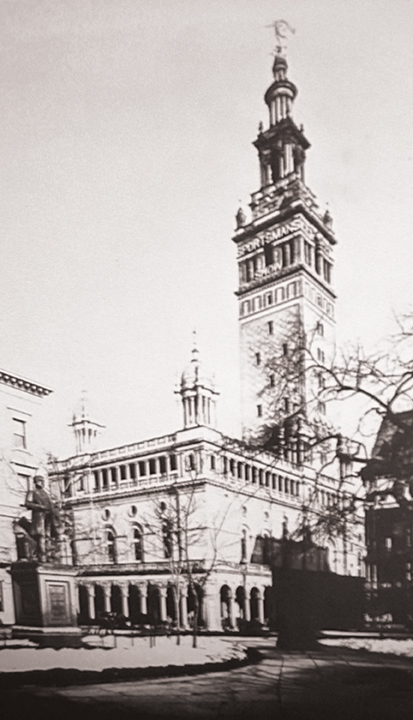
Just off the roster and barely qualifying to be placed in the category is another gun-heavy example. Though not a shot was fired we need to consider the worthiness of the inaugural Sportsman’s Exposition held at Madison Square Garden in the Spring of 1895.
Nothing ever really happens in this world until somebody has an idea, the starting point of all progress. Napoleon Hill, America’s self-help author and wellspring of wisdom and guidance, once summarized the concept thusly: “All achievements, all earned riches, have their beginnings in an idea.”
Many people have come up with potentially good ideas, but it invariably stops there. Ideas hopeful of bearing fruit are for naught without the requisite next step; an action being taken to progress the idea into something worthwhile.
As New York City’s general manager of the great Madison Square Garden in the 1890s, J.A.H. Dressel was in the business of hatching ideas and nurturing them into needs met or goals achieved. Keeping the Garden booked to its full productive potential was Mr. Dressel’s responsibility. His success was the Garden’s success. Keeping its calendar full was at times difficult, particularly during the late winter months. Keeping the space rented called for imagination and resourcefulness – ideas by another name.
The more Capt. Dressel considered the potential niches that remained unfilled, the louder the sound
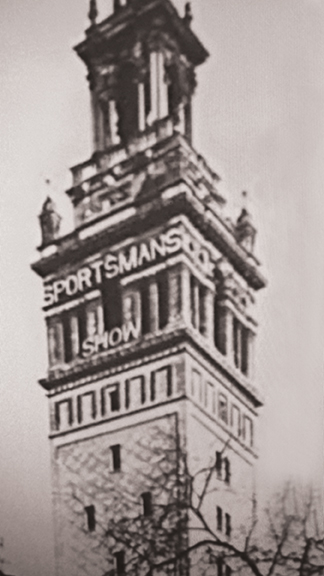
of opportunity knocking became. An out-of-the-blue brainstorm occurred to him like a thunderclap, as they often do. Opening the Garden to the hitherto untried and underserved sporting crowd, hunters and fishermen, plus the enthusiasts involved in other allied activities, and offering the sportsman the chance to be accommodated and feel surrounded by kindred souls. This was an unexplored concept, together with its own ready and receptive market. As ideas went, this one was untried, original, and full of potential.
Once the vexing “idea stage” had been surmounted, the action stage – for a person in Dressel’s position, is generally straightforward. To activate his plan,
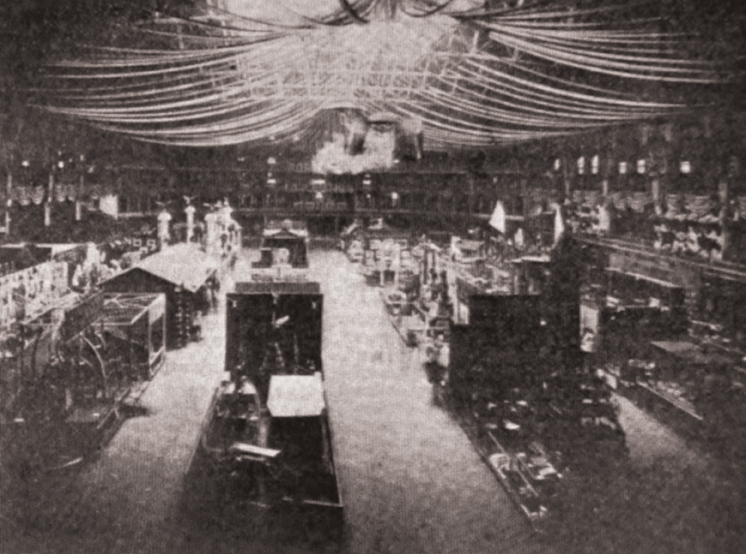
Captain Dressel canvassed industry leaders and advanced his proposal of a trade show – open to the public – targeting the metropolitan sportsman. Everyone concerned was at least familiar with the basic business concept, even though their industry had never formally organized one.
The opportunity to publicly – physically – showcase one’s line of goods to a receptive consumer base that had actively paid to be near them, clearly benefitted the manufacturer. Virtually every concern Dressel had contacted was enthusiastically on board.
Meantime, Capt. Dressel, the Madison Square Garden’s professional model of organization, advised his staff to prepare for a crowd of greater than normally expected size.
The prospective exhibitors were recruited and as they committed, they were assigned space to meet their stated needs. Dressel parceled out the available plots of square footage as his instincts and history with similar events guided him. He estimated space required from information submitted by vendors. Making the effort to cluster exhibitors by category was part of his common-sense system. The exhibitors were planning their exhibits within space limitations conforming to the Garden’s directives.
As always, separating and connecting were considered very critically. This too was the Garden’s concern. For its planners, this was a balance of accommodating a harmonious and appealing effect while avoiding a hodgepodge, thrown-together look. It was said that space was assigned for the Garden’s instinct and adjustment for placement of good neighbors.
One of the challenges faced by scheduled exhibitors was to put together an eye-catching booth that did their firms justice. Elaboration in these space-filling cabinets and display racks varied from bare bones utility to breathtaking. Many outfits had to make do as best they could, and if the serviceable fit the budget it was good enough. The timely completion of the furnishing was also a consideration.
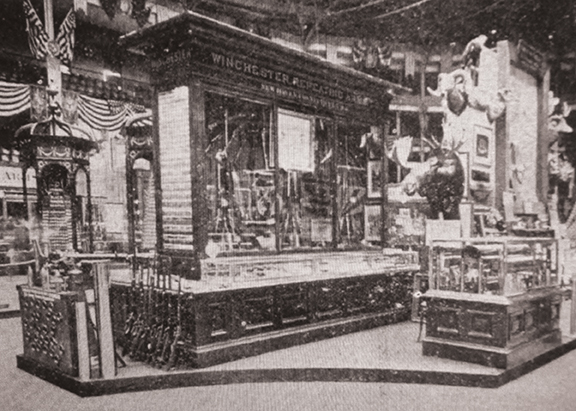
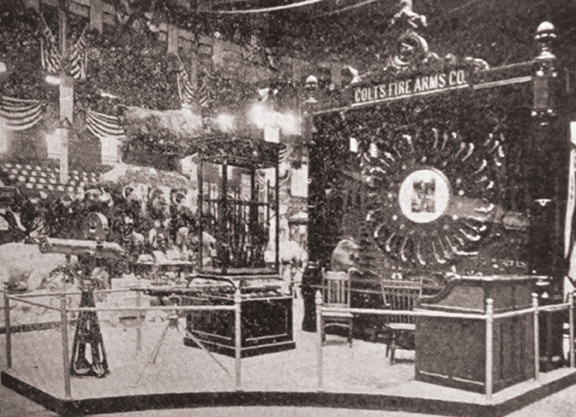
In 1893, some of America’s largest and better-established gun companies felt that a presence at the recent World’s Fair, hosted by the City of Chicago, would benefit them. Winchester, Colt, Smith and Wesson, Parker, and the Union Metallic Cartridge Company were among the U.S. arms merchants that set up displays at Chicago’s massive George E. Post Manufacturers and Liberal Arts Building on the sprawling fairgrounds set aside for commercial displays. The tendency of some New England gunmakers was to outdo the others when it came to lavishness. This was the “Gay 90s”, after all.
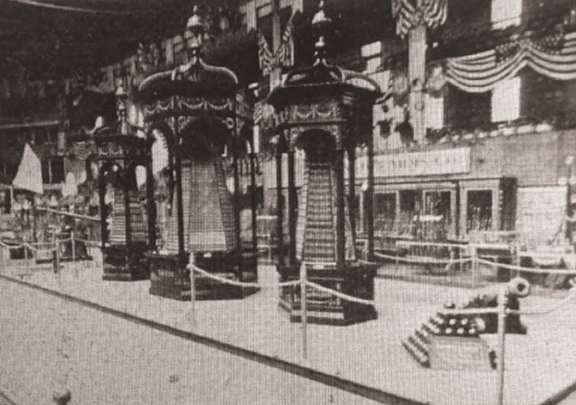
On display at the Windy City affair were some of the most highly decorated arms (done to the point of garishness) ever turned out on the planet. Their display stands and tables followed the same level of quality. Some of the World’s Fair booths were taken out of storage and set up at Madison Square Garden for another shameless flaunting at the 1895 Sportsman’s Expo.
Capt. Dressel regularly hosted trade shows at Madison Square Garden, but
what he was proposing to be successful, would require a regional exposure to spread the word and draw exhibitors, the trade, and the public. To this end, Dressel made his way to the cross-town publishing offices of Forest and Stream magazine and conferred with Yale graduate George Bird Grinnell, its owner and editor. Forest and Stream was a popular weekly magazine with a wide circulation of avid outdoorsmen, gun cranks, hunters, fishermen, amateur naturalists and anyone interested in any subsets of the blood sports, together with natural history and its allied branches. The two men sat down and discussed how one could benefit the other.
They formed a loose alliance and recruited a few partners with the necessary subsidiary talents. Together they formed the Sportsman’s Exposition Association and incorporated on January 8th of 1895. Forest and Stream agreeably acted as its unofficial public mouthpiece and its most effective promotional tool. Progress of the association’s proposed Sportsman’s Exposition received front-page mention thereafter.
Capt. Dressel was a practical authority on how these seemingly complex projects came together. Under the unified guidance of an association, and with tasks distributed according to specialty, progress toward an actual Exposition looked smooth and straightforward. The Expo’s reality seemed just as certain.
Among the mundane responsibilities of the Association was to solicit potential exhibitors and get their signatures on a contract. To further expedite progress, a mass mailing of 200,000 circulars (a number approximating the names on Forest and Stream’s subscription list) was sent to “every well-known sportsman throughout the U.S., Canada, and Europe.”
From the commercial sector, there was no shortage of interest. By late January, it was said that the point had been reached where half the available space had been spoken for. By mid-March, 34 firms had committed to occupy spaces at the exposition.
It was essential that certain industry big names were fully on board. Signing up quickly was the New York dealer in sporting arms, Von Lengerke & Detmold. Wasting no time in getting their fair share of prime space was the importing firm of Schoverling, Daly & Gales. Business giant and powder maker E.I. DuPont de Nemours got their pick of aisle intersections considered to be most advantageous.
The Expo Association was eager to accommodate what was considered a big crowd draw and essential to have on board, the Maine Guides Association, and just as indispensable, the Maine Central Railroad. Each of the big-name gun makers were committed to be there, and if they were smart, so were the smaller ones. Publishers in the trade, American Field, would be on hand. The lesser-known Recreation magazine would be represented by its flamboyant editor George Shields. His choice of booths would be a log cabin, one of five to be constructed inside the Garden for the occasion.
As time was running out, Madison Square Garden and Forest and Stream were deluged with requests for information. Potential vendors, at first skeptical or indifferent, now wanted a booth and scurried in earnest to ensure a patch of floor space. At this point most of the spaces remaining were only 50 square feet. The smart vendor had their exhibits already constructed and ready to transport and set up.
The Exposition Association’s secretary, F.S. Webster’s published statement in mid-March summarized what the public could expect, reinforcing what had already been amply instilled: “The Sportsman’s Exposition will not be a commonplace affair.” At that point in time, more exhibitors had signed on, raising the number of those committed to eighty. Day by day, the magnitude of the event was becoming more apparent.
Forest and Stream editor Grinnell and his staff did a masterful job of promoting the expo while wisely showing a personal detachment. The January 26, 1895, number carried this front-page nugget: “All involved in the management of the upcoming expo opine that the first annual Sportsman’s Exposition will mark an era in the history of the field sports of America.”
Throughout its coverage of all phases of the Expo, including weekly editorial updates, the paper took the professional pains to be unbiased. Meantime, on its pages there was a palpable sense of reader anticipation. Forest and Stream served as a clearing-house for the hundreds of letters showing interest in attending the upcoming Exposition. The paper kept its readers abreast of what wonders to expect and provided regular updates on newly committed exhibitors.
Meantime, Tatham & Brothers, who had the shot tower at New York City for 50 years, broadcast that they would have a working shot tower at the show. The ticket buying public could then see how shot was made. Its furnace was to be placed at the top of the 30-foot tower. Tatham intended to have it in operation at the event, and there were no OSHA regulations to prevent them.
The Expo, opening in a week, was given still more notice in the May 11, 1895, number of Forest and Stream. By then there was already a certain public expectation, but the Forest and Stream writer elaborated nonetheless: “The exhibits made by manufacturers and dealers will be varied and complete and will afford a striking exposition of the variety and perfection of the sporting goods of the day.”
Editor Spencer together with Archibald Rogers planned a booth to examine, measure, and compare 500 big game heads expected to be brought in for evaluation. Honorable Theodore Roosevelt was also involved in no small capacity. To the cause he contributed big game mounts from his own collection, as did other well-known sportsmen.
The Expo highly anticipated opened for its six-day run on Monday May 13, 1895. For the captivated masses unable to attend, Forest and Stream did not leave them in a lurch. Editor Grinnell accommodated them with this front-page pledge: “For the unhappy individual who is ‘chained to business’, he should do the next best thing – read about it in the next week’s Forest and Stream, which shall have as good a description of the Exposition as pen and camera can produce.”
Grinnell was as good as his word. The May 25th “Exposition Number” was a special 40-page edition. Its heavily illustrated coverage could not have been more comprehensive. Attendees could have expected to see exhibits of 15 gunmakers. Aisle-cruisers, dawdling at this booth or that, may have lingered longer at the cubicle of the recently established concern, where the Burgess Gun Company showcased the various grades of its new and novel folding 12-gauge pump-action shotgun. This was the gun that Theodore Roosevelt, as a New York City Police Commissioner was exposed to when an innovative and somewhat brash Burgess salesman burst into his office unannounced and rattled off six blanks quickly in an impromptu demonstration. T.R. instantly took a shine to the gun. With dummy shells, the novel gun and its Expo demonstrator got a workout cycling the action and ejecting the dummies in front of a crowd of onlookers.
The companies of Lefever and Hopkins & Allen each believed that appearance at the Expo was an essential investment. Both hopefuls were there and both were right. The Tatham Shot Tower was actually in the building, actually in operation and actually dribbling shot as a demonstration. The molten lead stream dropped into the water reservoir and emerged as shot in cloth bags.
William Lyman sat behind a table with his company’s line of rifle sights. New to the Lyman catalog in 1895, was a novel adjustable revolver sight, ready to show off at the Expo.
Just as it had at the World’s Fair two years previously, the lavishly appointed Smith and Wesson space, containing the same display cabinets, and the same selected, presentation grade, Tiffany and Company embellished revolvers. They slowed foot traffic and drew a crowd of gawkers who stopped and lingered at the sight of the finest revolvers in the Milky Way Galaxy. The Springfield, Massachusetts, S&W works was turning out 8,000 handguns a month.
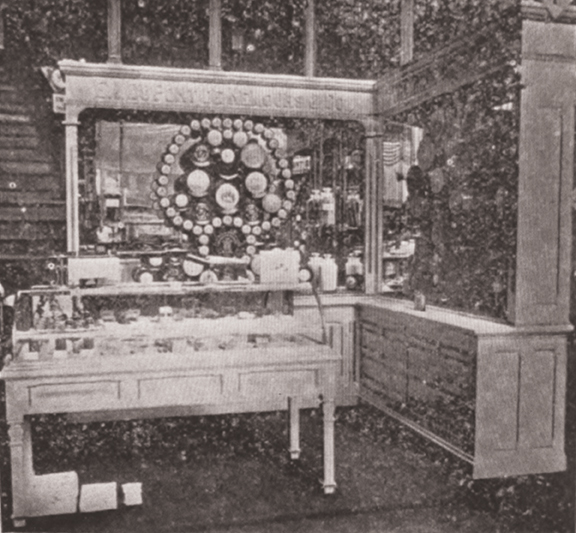
G.W. Cole used space No. 51 to put before the public his “3 In 1 Compound”, a general-purpose oil of his formulation. “3 in 1 Oil cleans, lubricates, and protects” all the gear that a person attending the Expo might use. Mr. Cole advertised endlessly and the company he founded still follows suite.
E.I. du Pont de Nemours and Co., known familiarly as DuPont, showcased its primary contribution to the sporting field, the manufacture of black and smokeless powder. They set up glass containers filled with the raw components to show the public. Other samples of smokeless kernels were contrasted to show size differences. Through visual aids, DuPont tracked a century of gunpowder development.
The Winchester Repeating Arms Co. booth at the Chicago Worlds Fair was considerably larger than the space allotted to it at the Sportsman’s Expo Nevertheless, the gunmakers lavish display cases used in Chicago, made the squeeze and got another round of use. The “Big Red W” had on display several specimens of their smokeless powder Models of 1892 and 1894, with all the imaginable embellishments that could be applied to a common gun. Their Single Shot rifle in the popular target configuration was on full display in its various styles and grades. There was even a specimen with an 18-pound barrel! The Single Shot could be supplied in the brand new .236 Navy cartridge and the smokeless .30-40 Army shell. Included in Winchester’s up-to-date arms at the Expo was their bolt-action repeating Lee rifle in 6 m/m rimless chambering and with “full patch” bullets. The Winchester people were kept busy handing out dummy cartridges to passersby. In the company’s shotgun line was its modern “trombone” action hammer repeater for the new smokeless powder shotshells.
At the booth of Schoverling, Daly, and Gates, the public encountered the famous Charles Daly side by sides, now being supplied with Krupp steel barrels. Their other offerings were hammerless and three-barrel models in a number of grades. A nice representative selection was on display.
John Barlow, the “Ideal Man” himself, was on hand at the Ideal Manufacturing space, where his full line of reloading tools and bullet moulds could be examined.
At the Marlin Firearms Company exhibit, the public was able to view what could be done to dress up their bread-and-butter lever-action centerfire rifle. A rack filled end to end with engraved guns, some plated, some stocked in bird’s eye maple and others in sycamore. Two specimens of Marlin’s high-grade revolvers could be seen, and a pair of Marlin rim-fires that had spent the year in Europe with Annie Oakley. To get its fair share of profit from the current .25 caliber craze, Marlin had a proprietary chambering, the .25-36 Marlin, to compete with the lever-actions in another aisle.
Space No. 77 was occupied by Von Lengerke and Detmold, who showed off their Francotte guns, and their display of “Schultze” smokeless powder. They also touted their line of fine fishing tackle, and an aluminum bicycle that they handled. Also set up for public view was a variety of loading and ballistic instruments not generally available. They distributed high-end fishing tackle and gear for the well-heeled and discriminating sportsman. There were a lot of lookers and tire kickers at the VL&D booth.
The Union Metallic Cartridge Company’s space took up 500 of the Garden’s usable square footage. Long-term industry personality William Morgan Thomas, “UMC Thomas” to the vast ammunition trade, and “Old Happy” to his friends, superintended the display. It took a lot of space to properly display all the types of ammunition that Union Metallic Cartridge Company loaded.
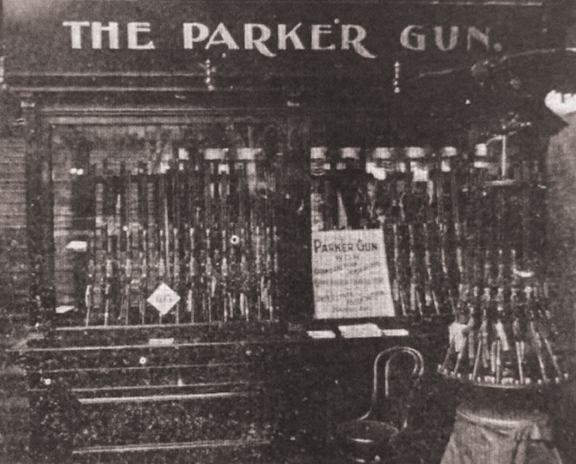
Captain A.W. duBray was in charge of the Parker exhibit. For 30 years the Parker gun had been known as” the gentleman of guns”. Parker used the same lavish display, a padded revolving case it had used at the World’s Fair in Chicago two years earlier. Parker showed to the world 103 guns at the fair but only 75 at the inaugural Sportsman’s Expo.
Bigger would seem better, but the modest exhibit, no small presence at the Expo, manned by one or two standing behind a tabletop display case of their goods. One or two chairs behind the table, together with a pair in front, hopeful of being filled by an interested passerby, constituted a booth in that setting. One can easily visualize William Lyman or Webster Marbles, hopeful of making a splash, displaying their entire line of gun sights housed in a single glass case resting upon a common table. There was a fair number of this sized operation at the 1895 inaugural Sportsman’s Expo and their proprietors’ hopes for a successful show were just as lofty as the players occupying 700 square feet.
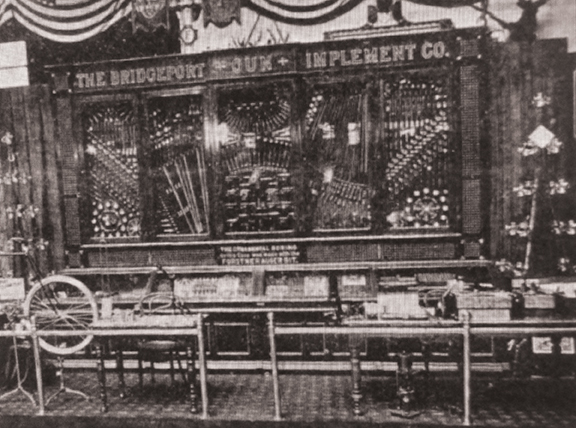
The local Bridgeport Gun Implement Company from very nearby 313-315 Broadway had a tasteful display of their complete catalog of shotshell loading tools, wads, brushes, and cleaners. H. B. Cannon was on hand to take questions. The BGI Co. space had a homey look that included a single chair. There was no room for two.
Nearby, the booth of the United States Cartridge Company, in contrast, was “attractively furnished with oriental rugs, divans, and comfortable chairs” and was situated in a “choice part of the Garden”. People dropped in to look at their selection of loaded ammunition.
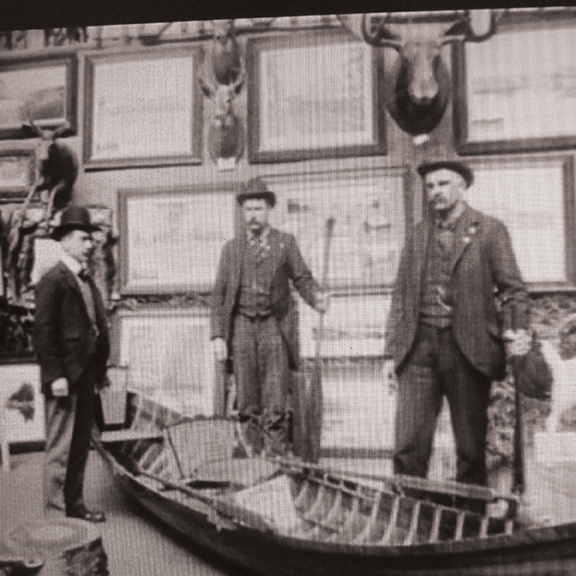
A hide and horn-laden log cabin depicted the Adirondacks and its guide guild. Jay Matheson and Ed Grant, two popular guides, represented the region and the industry. The Maine Guide Association had a similar set-up. There was a lot of “tire kickers” at each location. The Guide Association of Quebec, a popular destination of Eastern sportsmen was there to sell hunting trips. Also, just as focused, was the Quebec Central Railroad (the way to get North) who wisely had booked its space very near to the Guides Association.
Quality specimens of the taxidermist’s art were very abundant on the Expo floor. An eye-catching example of the best of them was a grouping of North American bison being pestered by a handful of wolves. William Hart displayed African lions and Indian tigers done at his studio. These exhibits drew a continual crowd for the duration of the Expo C.G. Gunthers, the well-known New York City furrier, took up four spaces doing justice to his striking collection of mounted specimens and heads of North American big game. The collection was first displayed to the throngs of mankind attending the Chicago Fair in 1893.
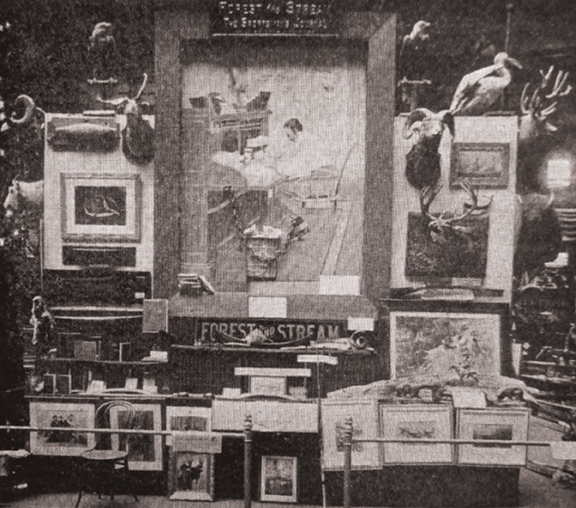
The Expo’s host and promoter, the Forest and Stream Publishing Company, made it known with their prominent end cap spaces No. 73 and No. 74, that they intended to be encountered and engaged. They had encouraged their readers to drop by. The people on the paper’s masthead occupied the booths, greeted show-goers and demonstrated their faith in the Expo’s concept, and that their guidance led to the project’s reality. On the most prominent wall of the Forest and Stream booth hung a painting “Chained to Business”. The image’s star player, a disheveled editor sitting at his desk in front of a high stack of paper, represented being deprived of recreation.
In a cabinet nearby was the entire run of the paper, in bound volumes, since Volume No. 1 in 1873. Among the sparce adornments on display at the booths was Davy Crockett’s rifle – on loan from a Crockett descendant.
Elsewhere in the sportsman’s literature department, Shooting and Fishing’s nook was cozy and inviting. It received its share of notice. Recreation magazine, new to the scene, and the somewhat better-established Outing magazine both thought it essential to be behind a booth at the Expo
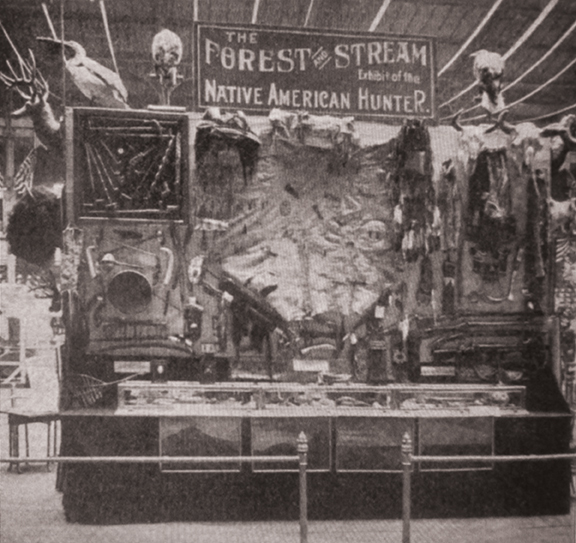
Forest and Stream Publishing Company had another exhibit which displayed an impressive gathering of Indian hunting paraphernalia that the staff had acquired in its travels. It would have taken 40 pages of typed text to convey what a few minutes in front of the display would communicate. At the time, this sort of relic was not uncommon, but it wouldn’t be too many years before a collection such as this could not be put together.
The September 18,1895, issue of the New York Times reported a commitment to a second exposition after the phenomenal success and acceptance of the inaugural Expo The second one was promised to be on a larger scale.
A Sportsman’s Expo at Madison Square Garden continued to be an annual event for several more years. The first one in 1895, following the formula of J.A.H. Dressel would always be considered the best of them, and was the unbeatable model for those to follow.
Predictably, Dressel’s successful show would be copycatted without shame or apology. Just as soon as it could be arranged, a Boston promoter instituted the New England Sportsman’s Expo Their 1898 event was an eight-day affair in March of that year. Boston’s Show, an American institution, is still held each year at the Mechanic’s Building in that city. Baltimore announced its own Expo in April of 1899. In the Midwest, Chicago hosted one for its sportsmen.
For whatever good reason there was for the Sportsman’s Expo to bow to what had been convention, by 1915, it had broadened its scope and its title. It was by then known as the Annual Sportsman’s and Travel Show. And Capt. J.A.H. Dressel, the “Good Idea Man”, continued to fill Madison Square Garden with attractions, hope, and opportunity until his death in 1926.