

Early Thoughts on .22 Rimfire Twist Rate
feature By: Steve Garbe | October, 26
For those interested in the 22 Long Rifle cartridge and the accuracy rifles for the same, .22 Caliber Rifle Shooting by C.S. Landis is a necessary read. Published back in 1932, it documents many of the early day efforts and experiments to improve the accuracy and reliability of the 22 Long Rifle cartridge and the rifles that fired it. I revisited this excellent book recently and a particular sub-chapter caught my eye. Titled Effects of Various Twists on Accuracy – Six and Four Land Rifling, it delved into experiments by various riflemen on decreasing, not increasing, the twist rate of the .22 caliber barrel for best accuracy with ammunition that exceeded 1100 fps. The then-new Super X ammunition was generating interest as a target loading among serious competitors and some interesting discussion concerning proper twist rates for “high-speed” .22 ammo took place. We thought that this would interest today’s .22 riflemen who have been experimenting with faster twists in the 22 Long Rifle; have we possibly been going in the wrong direction? The discussion on the merits of six or four groove rifling were also quite interesting and is one currently being debated by modern-day 22 Long Rifle shooters. Here’s that excerpt from Landis’ excellent book
Effects of Various Twists on Accuracy – Six and Four Land Rifling
“The general introduction of High Speed .22 Long Rifle ammunition during the summer of 1930 and the year 1931 introduced a new factor in the boring of rifle barrels for not only the .22 Long Rifle but also for the boring of those .22’s which are intended to be used with the three lengths of cartridges, the Short, Long, and Long Rifle. The average increase of velocity of approximately 20% obviously was destined to have a direct bearing on the accuracy of shooting as well as in the change of sighting necessary to place the group in the bullseye.
“For a great many years rifles intended for the Long Rifle only have been rifled with a twist of one turn in sixteen inches. A good many of the .22 repeaters intended for the three lengths of cartridges or for the .22 Long only were put out with 17-inch to 20-inch twist and some of the .22 Short Stevens barrels at least were made with a 25-inch twist. Everyone knows that the Stevens barrels were shooters.
“Winchester men have always leaned heavily to the 16-inch twist for any rifle using the Long Rifle cartridge – that with the standard ammunition developing around 1030 – 1100 f. s. velocity.
“ Roy Riggs of Western Cartridge Company wrote not long ago: “The normal and generally accepted pitch for the rifling is one turn in 16 inches for a 40-grain, caliber .22 bullet having a muzzle velocity between 950 and 1100 f.p.s. We have known for a long time that ammunition in barrels so bored was indicated as being quite stable.
“When the Super-X cartridges came on the market I and a number of my close friends, interested in small bore target shooting, noted immediately that the increased velocity 40-grain bullet had a tendency to a 9 o’clock, 3 o’clock deviation in wind. With but one or two exceptions we seemed mutually agreed that it was due to over-stabilization, resulting in an exaggeration of all deviating influence within the bullet itself, such as eccentricity, distortion resulting in eccentricity, and other stabilization errors, the product generally of too much spin.
“The reduced time from muzzle to target was desirable and we wanted to retain it because that reduced the time of exposure to the wind. But we wanted to get rid of the high rate of spin. The answer was to decrease the amount of pitch.
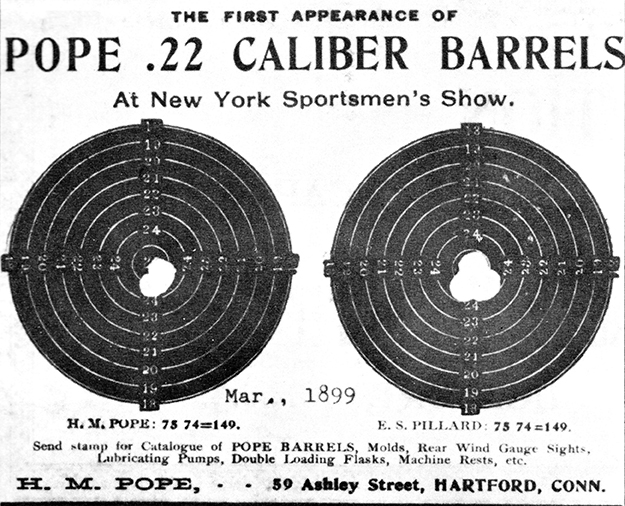
“Walter Kelsey of Tarrytown, N.Y., a most excellent eastern small-bore rifleman, a student of ballistics and a careful observer has been experimenting on his own home range for some time with his various rifles having twists from 16 to 20 inches. The latter I think is his favorite Pope barrel he usually has mounted on his fancy Ballard action.
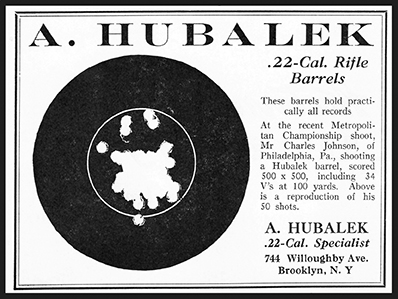
“Walter has a Hubalek-type machine rest and has shot many 10 to 15-shot groups from 100 to 200 yards with the various rates of twist, 16, 17, 18 and 20, and has repeatedly mentioned that he can see very little if any difference in accuracy of the three rates of spin. In fact, he was pretty well convinced that the 20-inch twist shot as well if not a bit better at 200 yards, than the others. Walter generally uses Palma or Palma HiSpeed although he has tried most everything good on the market as it came out.
“ Another question perplexing riflemen has been the debate between 4 land and 6 land rifling. Springfield has used both, but I believe has said that it can see little if any superiority in either. The 4-groove rifling is obviously the quicker and easier to cut but looks coarse and crude as compared to the 6-groove rifling which has been standard in the 52 and other commercial .22 rifles. There are other examples, however, of 4-groove rifling which has proved successful, Savage, I believe, having done much experimenting along the same lines.
“ A good many .22 barrels have been made from nickel steel, chrome-vanadium steel, and other hard, alloyed steels designed to wear better and to rust less than soft steel barrels with corrosively-primed ammunition.
“B.S.A. and Winchester made most of the factory barrels of these types but apparently with not too much success so far as accuracy went as while some exceptionally fine nickel steel barrels have appeared it is harder to bore them absolutely straight and true and uniform in diameter than the soft steel so that as a result various concerns have been experimenting with various platings on the interior of the barrel to make them wear better. In other words, soft steel barrels bored and rifled and plated, the idea being to give the evenness of boring of the soft stock with the hard surface of the hard steel.
“In this regard it is just as well to remember that the M1 Springfield rifle barrels are all hard steel barrels, and not all of them are reputed to be as good shooters as some other match barrels.”
Interesting information, and I was not aware that Arthur Hubalek’s preferred .22 rimfire twist was one in 17 inches. I, like many other modern-day riflemen, had assumed that a tighter twist was needed. Running the Greenhill formula on a 40-grain .22 bullet one comes up with a 15.07 twist rate. The Greenhill formula is based on a muzzle velocity of 1450 fps and I have always tightened the Greenhill results by two inches for best performance in my BPCR rifles; so now we are looking at a 13-inch twist! One factor that enters into the twist-determining process is that the .22 caliber heel bullet is also hollow-based. When running Greenhill on a bullet length allowing for the .050 hollow base we get a required twist of 16.76 which is remarkably close to the industry standard of 16 inches.
I have, in my shop inventory of .22 caliber barrels, some that came off Winchester Winder muskets chambered for 22 Short. I believe these have the 20-inch twist and I’m contemplating having one of these fit to an action to see if the bullet prints from 22 Long Rifle ammunition are stable at 200 yards. If they are, it would argue in favor of a slower, not faster twist and could require a match-grade barrel to be made with the slower 20-inch twist for further experimentation. We consulted an old Stevens catalog and it was mentioned that the 22 Short barrels that they manufactured indeed came with a 1-25 twist. Measuring a 22 Short slug gave us a length of .350, allowing for the .030 hollow base. Greenhill then specified a twist rate of 21.3 inches. The Stevens twist would seem to be too slow, but having owned a couple of Stevens Schuetzen gallery rifles in 22 Short I can assure you that at 50 feet, at least, they certainly did shoot well and the bullet holes were stable.
I would make one comment on the above quoted information from Landis and that is that the increased wind drift from the Hi-Speed .22 ammo that they noted was not from, I believe, too much spin but rather from simple ballistics. We know now that wind drift is increased the closer one gets to 1600 fps, due to the position of the bullet shock wave. This is still debated in some quarters, but my own experience has satisfied me that this phenomenon is true.
We tend to think that our modern-day ideas are the last word on a shooting topic, but paying attention to what was done years ago always provides more perspective. We intend to work more on the optimal twist rate for accurate 22 Long Rifle shooting and will keep you posted.