

Product Reviews
Sharps Firearms – A Collector’s Guide / The Case Sodbuster,
column By: Leo J. Remiger / Mike Nesbitt | October, 26
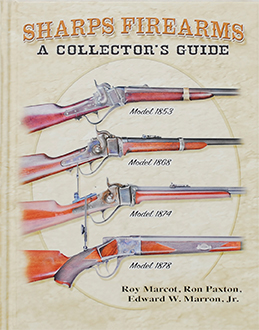
Sharps Firearms – A Collector’s Guide
Leo J. Remiger
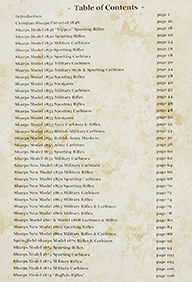
In the Table of Contents below you can see the variety of subjects covered, from the initial Christian Sharps Patent of 1848, to the Sharps Lee Repeating Rifles and everything in between, including double-barreled shotguns, line throwing guns, single shot pistols, pistol-rifles,
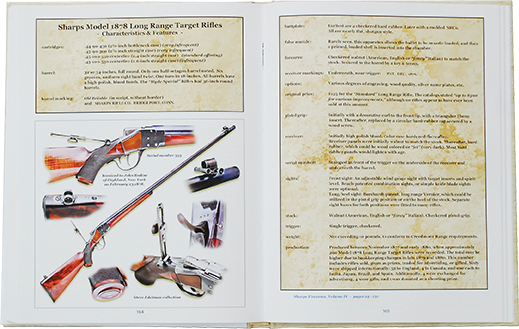
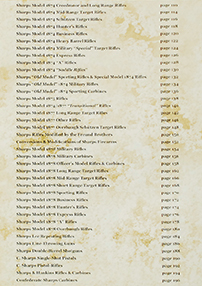
There are 77 entries in the Table of Contents and each entry has at least two pages providing specific information on that subject. Included are production figures (when available), barrel lengths, calibers, markings, sights, and information on stocks and whether engraving was an option. Other pages show the reader how to differentiate between various models; for example, the differences between a Model 69 and a Model 74 Sharps such as the thickness and configuration of the side plate and bridle, including the various barrel markings.
For anyone interested in correctly identifying your Sharps firearm, whether percussion or center fire, this book is a convenient, well-organized resource. Roy Marcot and Ed Marron provided the text and Ron Paxton provided excellent photographs to illustrate the superb text. Sharps Firearms, A Collector’s Guide, by Roy Marcot, Ron Paxton, and Ed W. Marron Jr., is hardbound and consists of 206 pages.
The book retails for $60, plus $5 for postage. When ordering by mail, please make checks payable to Northwoods Heritage Press. Mailing address: Roy Marcot, 4680 W. Placita Casa Sevilla, Marana, Arizona 85658. If you need further information, please email Roy at roymarcot@msn.com.
The Case Sodbuster
Mike Nesbitt
As our conversation went on, Steve commented, “You know, an old-style knife that I have always carried has been a Case “Sodbuster”. That knife’s design pre-dates a Barlow and for a simple, no-frills, “get ‘er done” pocket-knife, you can’t beat one. And, they are made in America. I know that you can dress an elk with one pretty easy and skin a big black bear as well!”
Steve’s comments put me on the trail of a Case Sodbuster because I had never owned one. Of course, I had seen them for years after Case Knives introduced their Sodbuster in 1967 or ‘68. While I have generally carried a pocket knife, one of the Sodbusters just didn’t come my way.
Another story about the use of a Sodbuster came from an old friend several years ago. My friend and his brother had gone out to dinner, both enjoying steaks at a distant restaurant. After their dinners were served, it quickly became apparent that the steak knives they were “issued” with their meals were not sharp enough to cut the meat. So, they both whipped out their Sodbusters and dove into those steaks with delight. We could say the situation was saved by those Sodbuster knives.
When Case introduced their Sodbuster, they became the first major American knife maker to market this pattern. Since that introduction, the Sodbusters have been copied by other makers which is simply the highest compliment which can be given.
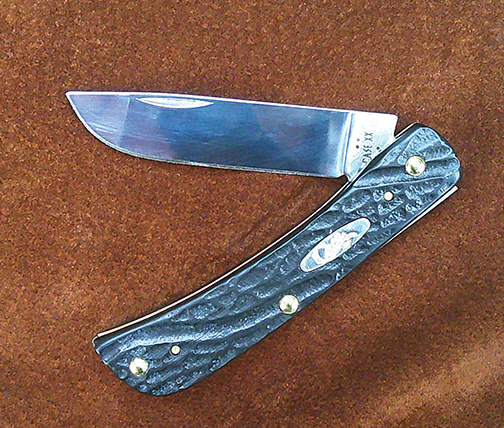
Don’t let the fact that the knife has no bolsters fool you, these knives are very sturdy. Starting with the blades, they are made with a surgical steel which offers very good cutting edge, long-life plus corrosion resistance. These folding knives feature a slip-joint connection with the grip, as well as the back spring, which has a lot of snap to hold the blade open, as well as closed. The standard or large Sodbuster has a 35⁄8-inch blade of a “high-point” skinning shape that is excellent for a variety of uses.
A wide choice of grips are available on the Sodbuster knives, which have brass liners between the blade and the grips. Likewise, the blades are offered with various etchings but I must admit my favorite is the plain blade with no etchings. Also, Case makes the Sodbuster Junior as well, a somewhat smaller knife with a 2¾-inch blade. All compliments given to the standard Sodbuster knife also apply to the Sodbuster Junior. The smaller Sodbuster might be more comfortable for an everyday carry knife.
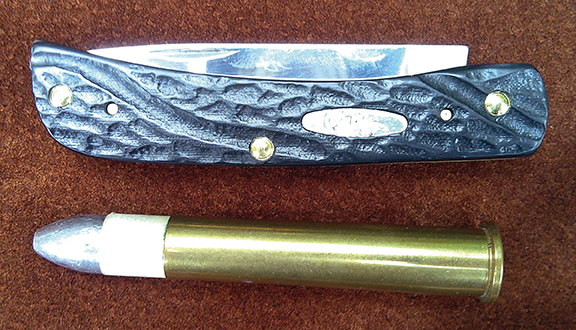
The Sodbuster Jr. is what I settled on for my own pocket. The knife in the photos is mine – with the black jigged composition grips as well as the “Case” signature shield, along with the brass pins and liners. One thing I will quickly mention about this new knife, it sure is sharp!
Prices for the new Sodbuster knives are just as variable as the other choices. My basic favorite is actually the knife with the yellow synthetic grips and that is just about the least expensive, with a price just over $40. However, all knife dealers seem to have sales on the Sodbuster knives, which can bring the price down at least slightly. There are many choices for the grips ranging from synthetics of other colors to various grip materials. Real favorites include the burnt and jigged bone grips, as well as the stag grips which are often available. However, the natural grips do raise the price.
After being in production for nearly 70 years, we can call the Case Sodbuster a traditional American folding knife. One can also assume that the buffalo hunters from 150 years ago often carried a similar pocket-knife. Without looking into the past, if we want a traditional folding knife to go along with our buffalo rifles today, one of the Case Sodbusters would be a very good choice. The best part is the Case Sodbuster knives are American-made.
The Sodbuster knife can be purchased at any sporting good outlet such as Amazon, Bass Pro Shop, Blade HQ, Cabela’s, Case Knives, Walmart, Zoro and many more. There are a wide variety of styles and prices vary accordingly.