

The Wyoming Schuetzen Union’s “Center Shot”
Casting Shadows: Cashing in on the Roosevelt Safari
column By: Jim Foral | June, 26
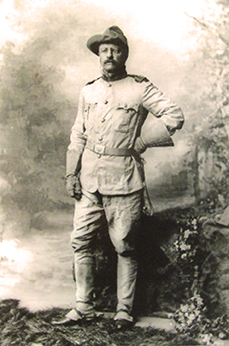
Those who profess themselves to be good are generally that way solely for the sake of goodness and are so inclined by the purest of motivations. Virtue, after all, is its own reward. On the other hand, many of the less principled of this world are kept in line only by the fear of punishment. From time to time, both convictions find themselves occupying a common and obscurely-bordered middle ground where direction is uncertain and the outcomes of choices are often double-edged. Those already strayed from the straight and narrow path are presented an invitation to push the envelope, while the best the upright can hope for is an eased conscience.
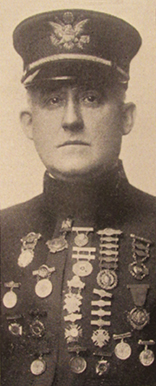
Before Taft’s inauguration, the ordered guns were delivered to Washington. Attending the shipment as Winchester’s agent was gun assembler Albert Laudensack, one of the top competitors on the high-power and gallery rifle ranges. Laudensack was to assist the President in sighting and adjusting his new rifles. The two repaired to the short range Roosevelt had set up in the basement cellar of the White House. After breaking for lunch with the First Family, they resumed their work, at which time T.R. interrupted to wag a still-Presidential forefinger under the nose of the Winchester representative and issued a firm directive. He stipulated that in no case should his name be used in connection with advertising purposes.
Laudensack, of course, immediately relayed the instruction to company president T.G. Bennet, who in turn informed Advertising Manager William Clark, and emphasized its importance. The President’s warning somehow slipped out of New Haven and became known throughout the industry.
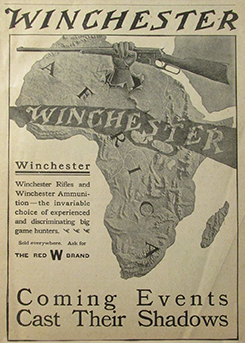
Former President Roosevelt had been in British East Africa little more than a week when Winchester’s first advertisement appeared in the May, 1909 magazines. For most Americans, the gauntleted hand holding aloft a Winchester Model 1895 thrust through a map of the African continent, provided a reminder of the same glove that grasped the same gun in Cuba 11 years prior. That coming events cast their shadows was the ad-writer’s statement, but the inference was not hidden.
The buck stopped with Bennet and he held himself accountable. Understandably displeased and fearful, Bennet penned his regrets and expressed his sincere apology. Expecting a scathing chastisement, he braced for the dreaded aftermath. Roosevelt’s reply, one of many hundreds of letters he wrote from the bush, might have been tempered by his admiration for Winchester and its rifles. T.R. was actually amused. He seemed to enjoy the novel publicity, and could find some humor in the gun-maker’s trying situation. Bennet was assured that no harm was done.
Long before Roosevelt’s departure, Winchester Repeating Arms had concocted a plan to milk the maximum benefit from his absence – an opportunity not to be overlooked. Already they had double-timed to completion duplicates of the Roosevelt-ordered lever actions and intended to publicly display them as part of a traveling exhibit while national interest in the ex-President’s hunt was at its peak. Their number included three high-grade Model 1895 lever action rifles in .405 WCF, and another in .30-1906 chambering. A fancy Model 1903 rimfire auto-loading rifle could also be seen, together with a lavish Model 1892 .44-40. A straight-gripped deluxe version of the Model 1897 pump was the lone shotgun. Perhaps to blur the actual focus, the exhibit included several other “highly finished” examples of their line to show what could be done. Outside the President’s grouping was a fully nickel-plated 1895 model in .30-40 caliber with gold trimmings and stocked in bird’s eye maple, and a .30-30, stocked in fancy walnut and hand carved with grape leaves with a sweep of scroll work. Many of the other guns received the same unstinting treatment. The exhibit traveled by rail along a route that took it through major cities from coast to coast. Capt. Laudensack superintended the operations and was given three Winchester employees as assistants.
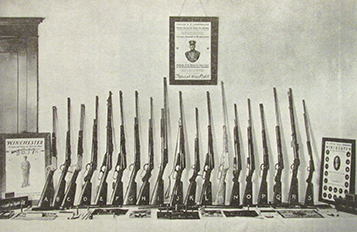
Depending on who was asked, the traveling exhibit skirted the blurred line between advertising and not. Bob Kane, Arms and Ammunition editor of the popular Milwaukee based monthly Outers Book, was on hand when the exhibit stopped in his hometown and covered the affair for the magazine. Likely aware of now-citizen Roosevelt’s rigid command or the matter’s particulars, Kane was able to offer an unbiased assessment based on what he considered plain to be seen. He submitted in the August, 1909 number of Outers that the “exhibit served as a splendid piece of advertising for the Winchester company.”
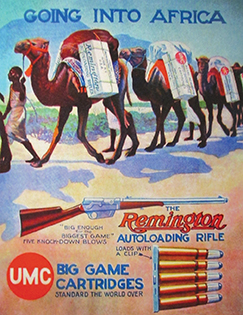
A list of guns packed for the Roosevelt expedition had been published in Field and Stream and elsewhere, and was purportedly received from Roosevelt himself. This listing failed to mention the Remington guns, and their use wasn’t recorded in T.R.’s own account of the safari. It is thought that some autoloaders were sent to the White House in the hope that they would be used. It’s never been necessary to identify someone by naming them, and Remington’s tactic just skirted T.R.’s edict. Still…no harm, no foul.
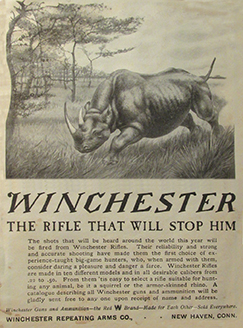
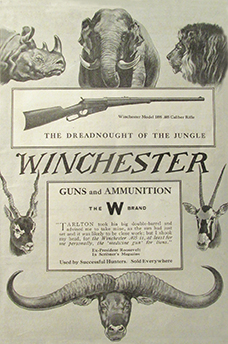
By the summer of 1909, Winchester had learned to play it safe. Without naming names and drawing rein on shadowy illusion, the still-stinging ad team settled on an illustration of a charging rhino with the declaration – “Winchester – The Rifle That Will Stop Him”. The innocuous text of the July ad began: “The shots heard around the world this year will be fired from Winchester rifles.” No one had to wonder from where these shots would emanate.
At some point Roosevelt had agreed to write an exclusive narrative of his Dark Continent adventures for Scribner’s magazine. The series was composed while encamped on the African savannas, and later compiled into his wildly popular book African Game Trails. In the first installment, printed in the October, 1909 number, T.R. touched upon the subject of his guns and numbered the Winchester 405 with some others. This citation changed the rules dramatically. While the use of his name was officially off limits, his published by-line could now be considered fair game.
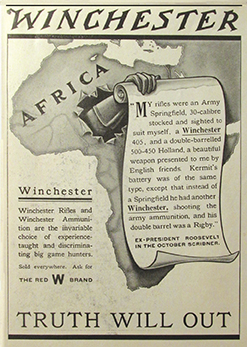
Winchester seized the opportunity and scurried to put a full-page advertisement in the November magazines. The ad department chose to use a variation of its initial pitch, substituting a scroll bearing Roosevelt’s citation for the 1895 caliber lever gun piercing the African map. “The Truth Will Out” the ad promised. Time would tell.
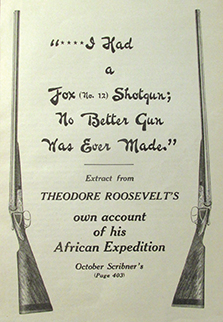
The A.H. Fox Gun Co. also benefitted from this lifted restriction. Having presented T.R. with one of the finest side-by-side shotguns ever turned out by an American gun maker, they were finally able to broadcast it. Starting in November 1909, Fox’s tastefully simple ad ran for several months. The shotgun was a lavishly elegant 12 gauge of their highest FE grade, masterfully engraved, gold inlaid and extensively checkered. Roosevelt’s ringing endorsement of six golden words –“No Better Gun Was Ever Made” – shined like a beacon across the full page.
The Ithaca Gun Company presented Mr. Roosevelt with a double shotgun opulent enough to rival the Fox, and flaunted the arm across the pages of the November, 1909 periodicals. The Ithaca shop journal records it as a 12-gauge “Flues” model, Grade No. 4 with Krupp steel barrels. It bore serial number 182899. An engraved bald eagle on the trigger guard was its only extra ornamentation. The gun was shipped on February 18, 1909, scarcely a month before embarking for Africa, and thus did not appear on unofficial inventories.
Ithaca’s ad men proved themselves to be less than rigid upholders of the T. Roosevelt imperative. Their claim that “the finest gun that went to Africa with the Roosevelt party” was worded evasively enough to be contestable, yet sufficiently vague to leave a leg to stand on. The few bird-shooting references in T.R.’s book mention only the use of the Fox, which seems to support that gun-maker’s assertion that “the Fox was the only shotgun the Colonel took with him”. The Ithaca may have tagged along and was shot by Kermit Roosevelt or anther of the “party.” Today, no one seems to know the truth. In any event, Ithaca got a lot of mileage out of this ad. It ran for many months.
Some felt entitled to hop the gravy train without buying a ticket. Most of the sporting magazines then carried a back page or two of miscellany, rifle and trap scores, trade and industry goings-on, and other newsworthy odds and ends. These columns used titles such as Stray Shots, Random Gleanings, Trade Notes, and ‘Twixt You And Me’ and were particularly lively during 1909. Editors compelled to oblige regular advertisers, turned a blind eye and printed what was submitted. “Roosevelt Likes the Fox Gun” and “Roosevelt Uses an Ithaca” were representative titles. This tactic wasn’t advertising either, but smacked of it. Everyone was guilty of this; it varied only in degree. They all seemed to get away with it.
Webster Marble of Marble’s Safety Axe Co., in particular, had mastered the shifty art of appropriating magazine space. His announcement of new products, disguised as customer’s endorsements, was a regularly done practice on this no-cost forum.
On the off chance that it would be mentioned, Mr. Marble had delivered to the White House his entire, unrequested, and complimentary line of outing equipment and camping gear. He then made an advertising point of it. Marble had sent the same kit to the office of Dr. Frederick Cook, a claimant to the discovery of the North Pole in 1908. “Marble goods to the North Pole,” his ad read.
Roosevelt departed Africa in March of 1910, and the Great Advertising Challenge of 1909 finally ran its course. The ad departments of a number of gun companies had risen to the task by ingeniously dipping into a previously untapped wellspring of creativity, resourcefulness, and sophistry to make their tremendous obstacle wieldy. In so doing they met the call without stepping on important toes and demonstrated that harmony prevails when everyone who plays by the rules can expect a certain amount of slack.