

A Funny Thing Happened at the Range Today
feature By: Bob Glodt | June, 26
I have been involved in Black Powder Cartridge competition since the late 1980s. I don’t remember what year it was when I attended the first rifle match, but I do remember my first competition was at the National Championships in Raton, New Mexico. Not long before this match, I purchased a Shiloh Sharps rifle from a friend. Wolfgang Droege, the founder of Shiloh was also present at this competition. I was thrilled when I was able to meet Wolfgang at my first match. Although I have been a shooter all my life (including muzzleloading rifles) I didn’t know the first thing when it came to black powder cartridge firearms. I didn’t even own a bullet mould for my rifle; I had to borrow one from a friend to cast bullets for this first match. There were four of us from the Texas High Plains who went to Nationals that year and it was the very first match for all of us.
As I look back on my many years of shooting Black Powder Cartridge Rifle competition, I can honestly say it has been time well spent. I have made some very close friends from all over the country. Some of these friends are still with us, albeit older but still hanging in there, and some have unfortunately passed on. There have been things happen on the rifle range over the years that are worthy of an article in this publication, if nothing more than to just pay tribute to the friendship and the camaraderie that keeps us all coming back to the next match and the next one after that.
Over the next couple of years, I developed a close relationship with Ron Long from Denver, Colorado. Ron passed away several years ago, but he was a wealth of knowledge, a top-notch rifleman, and an extraordinary gunsmith. His specialty was the 1885 Winchester Single Shot rifle commonly referred to as the “High Wall” rifle. His work was no less than phenomenal. I still own two rifles he built for me. Ron was highly respected for his knowledge and his shooting ability. He generally came out on top or near the top of every national championship during those early years.
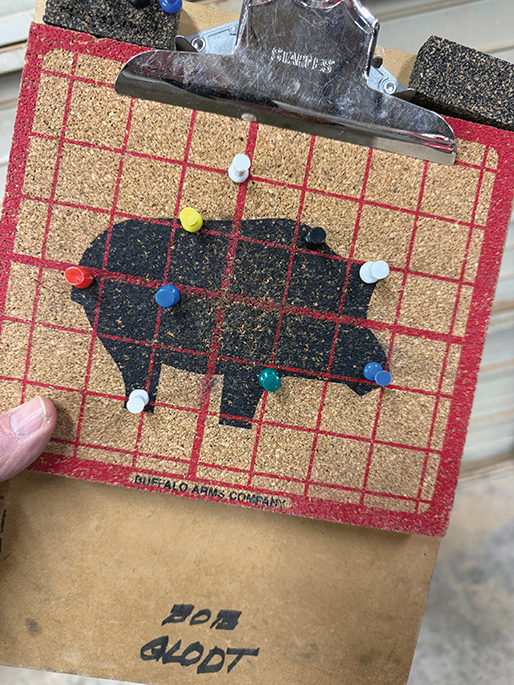
Ron recruited a guy named Mark from the Denver, Colorado area to get involved in Black Powder Cartridge competition. Mark was a machine gun collector and the most highly-strung guy I’ve ever known. Mark took competition seriously, but he had a nervousness he couldn’t shake when it was his turn to shoot. You could tell he was nervous; Mark would fidget around and start talking a lot before his relay began. He trusted Ron explicitly when it came to calling wind and calling sight adjustments. We were at the Raton Nationals and Mark was shooting with us. Mark was on the pig line, Ron was spotting and I had a spotting scope behind the line to observe. Before the relay started, Mark said, “I need to get eight of these pigs to move from AA Class to AAA.” Evidently the thought of that caused an increase in Mark’s nervousness because he was beginning to sweat and it wasn’t that hot at Raton in September. Mark came off his sighter and missed the first pig. Ron gave him a sight correction, and he hit the next pig dead center. But Ron pinned his hit on the pig’s nose. Mark looked at the spotting board in sheer terror and reached up to adjust his sight and Ron said, “Don’t touch that sight, conditions have changed!” Pig number three, dead center! Ron pinned the hit on the rump. Again, you could see the terrified look on Mark’s face. He reached up to adjust the sight and Ron said, “Don’t touch that sight, conditions have changed!” Beads of sweat were appearing on Mark’s forehead. Pigs four, five, and six were all solid hits but Ron pinned them on the feet, top of the back and the ear. Each time Mark reached up to adjust sights and Ron would say, “Don’t touch that sight, conditions are changing.” Now, I don’t know anything about drugs and I have personally never taken drugs, but Mark was needing some cocaine pretty bad about this time. I was watching Mark’s hits through my spotting scope and wondering what the hell was going on with Ron’s pinning hits, but I remained silent. This scenario was repeated until Mark had completed his relay. He ended up hitting nine out of 10 pigs and advanced to AAA class. His clothes were soaked with perspiration. I asked Ron, “Why did you pin his hits like that?” Ron said, “He would have missed half of them if he thought it was easy.”
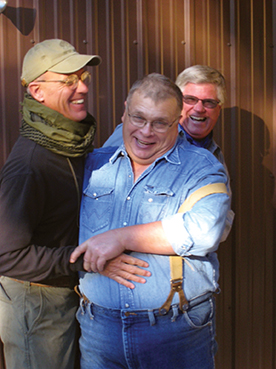
Another thing about Duke that you might not know is that he did not like the 22 rimfire cartridge; probably the only firearm cartridge that he didn’t like. Duke owned only one 22 caliber firearm and it was a High Wall “Winder” musket. He kept it by his back door to be used in case a coyote showed up at their house looking for a “cat treat.” This was the rifle that Duke was shooting at the 22 National Championships in Raton.
Well, Darrell and I were examining Duke’s Winder musket and we noticed that it was full of hair, even inside the action. When asked what was with all the hair, Duke told us he kept the rifle by the back door and the cats were always rubbing up against it. In unison we replied, “Don’t you think that you might ought to clean it?” Duke told us that it was fine. After Duke walked away to go and talk to someone, Darrell and I made the executive decision that we needed to clean all the cat hair out of Duke’s rifle. So, we disassembled it for thorough cleaning. Before we could get his Winder musket back together, my relay was called to the line. Darrell was spotting for me, so we went to the line leaving the pieces of Duke’s Winder musket neatly arranged on a paper towel. If you have never been on the 22 range at the Whittington Center, there is gravel behind the firing line. When you walk on it, it makes a distinctive crunching sound. I was on the mat, Darrell was on the spotting scope, and we were talking to each other when we heard this crunching sound from someone walking on the gravel behind us. Before we could turn to see who, Duke said, and this is an exact quote, “Why did you S.O.B.’s take apart my rifle?” Darrell and I were laughing so hard we couldn’t even reply. Duke marched off without saying another word and got Butch Ulsher to put his Winder musket back together. Darrell and I laughed about that all weekend.
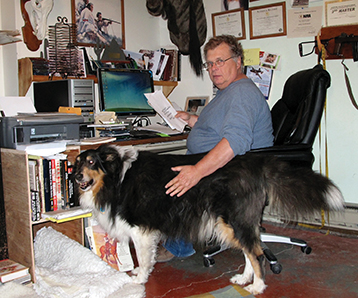
It took place while I was visiting Duke in Livingston, Montana. We had plans to attend the Shiloh Invitational match. I drove up to Livingston and spent a few days with Duke and Yvonne before the match. Duke was always partial to collies, and he had a tri-colored collie that went everywhere with him. That collie was his all-time favorite dog; he talked about it all the time. One morning, Duke and I went down to his range to shoot his Lewis machine gun. We finished shooting and loaded everything back into Duke’s vehicle. I don’t remember what type of vehicle it was, but it had a standard shift and was geared very low. There is a steep grade up to Duke’s house, so steep that a couple of times Duke had to depress the clutch, give it some gas and release the clutch to get the vehicle up the hill. We were almost in front of the Duke’s house when the vehicle stalled out a little. Duke depressed the clutch again gave it some gas and the vehicle lunged forward. About that time, we heard a yelp from a dog. We jumped out of the vehicle and saw that Duke had run over his tri-colored collie. Duke was heartbroken. He laid down in the gravel, put his arm around the collie and cried. I didn’t know what to do, so I just laid down next to Duke and put my arm around him. Neither of us said a word. I felt some guilt, if I hadn’t been there Duke would not have gone down to shoot that Lewis machine gun, and he would have never run over his dog. Duke never blamed me though.
Things were quiet that evening. Duke was very upset. The Shiloh Invitational was scheduled to start the following day. I told Duke that it would probably be best if we just skipped the match. He told me he needed to go because he wanted to be around friends and that would help him get his mind off what had just happened.
Duke took his miniature collie to the match with him the next day. This dog was by no means his favorite, and it wasn’t near as attentive or as smart as the tri-colored collie he had run over the day before. At the end of the match, John King invited us over to his RV to have hot dogs. Duke, John King, Ted Tompkins, and I were sitting in lawn chairs waiting for the hot dogs to come off the grill. Duke reached over and grabbed a hot dog off the grill and was going to feed it to his collie. The dog licked it a couple of times and caused it to fall from Duke’s hand into the dirt. Duke said, “If I knew you weren’t going to eat it, I would have eaten it myself, now it is all dirty!” Ted Tompkins immediately said, “Just pick it up, lick the dirt off and it will be clean!” This was typical Ted, always looking on the bright side. This comment struck me as funny and I couldn’t stop laughing. It wasn’t really a time to be laughing but Ted’s comment just hit me in such a way that I couldn’t keep from laughing. Ted then replied, “Look Duke, we are all very sorry about the loss of your dog, but you knew if you came here and the situation arose, we were going to give you some shit, it’s just what friends do!” Duke needed to hear that and I think it helped. But later, I told Ted in private, “Don’t ever make me laugh when we are in a situation like that!”
But, giving each other a little “shit” from time to time is just what we do. It’s part of the game and it’s a sure sign of friendship. So, until next time, I’ll see all you “a-holes” at the range!