

Product Reviews
Accurate Molds’ No. 43-215C
column By: Mike Nesbitt | June, 26

Dick said he worked through the Internet with John Kort on the design, along with Tom Ellis, the owner of Accurate Molds at that time. What they wanted to develop was an accurate long-range grease-groove bullet for the 44-40. To begin with, they tried several bullet weights, starting with the original 44-40 bullet (which is like Lyman’s No. 427098). While using smokeless powder loads, they found the best bullet weight to be 220 grains, and that design was listed as Accurate Molds’ No. 43-220C. It gave repeatable accuracy out to 400 yards while shooting at BPCR steel silhouette targets, and being fired in a Henry replica lever-action rifle. Dick included mention of using the 220-grain bullet to get consistent results on the 300-meter pigs.
After the smokeless loading was performing well, they switched to black powder. In order to allow the bullet to carry more lube, they “knocked-out” the center bearing band (43-220C has two lube grooves) and created the bullet with one large lube groove. Dick says that bullet worked very well with several different loadings of 3F and 2F powders, as well as when used with various lubes. Accuracy was very close to the results they had received with the smokeless powder loads.
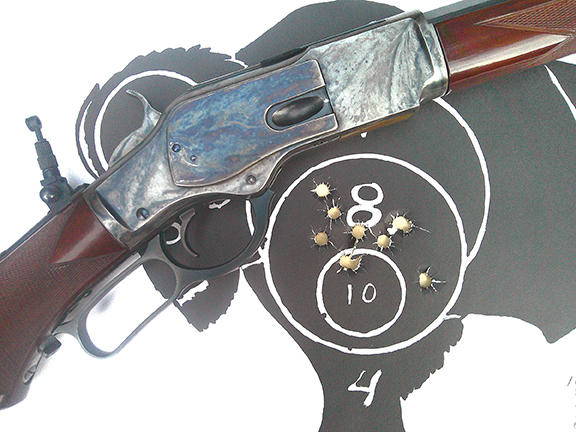
A couple of weeks later, I had my new mould, an aluminum double cavity version for dipper casting which I mounted to a set of RCBS mold handles. Casting with the new No. 43-215C began almost right away, using a mixture of approximately 25-1, lead to tin alloy.
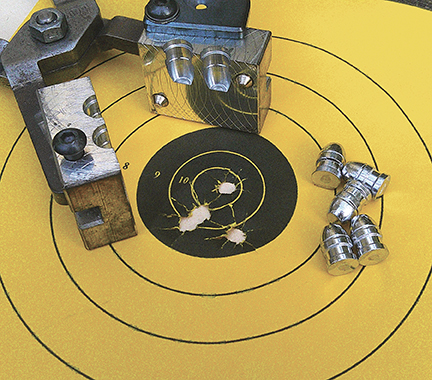
Initially, I did not make any accuracy comparisons that I could depend on. The reason for that was because I needed to sight-in my rifle. This was not just for the new bullet, as my rifle was hitting to the left, costing me points in our club’s lever-gun matches. Because my rifle is fitted with a Lyman tang sight, which has no windage adjustment, my corrective action was to drift the front sight a bit to the left in order to get the rifle’s windage adjusted a bit to the right. Naturally, my first attempt in drifting that sight was too much and I had to undo the first correction, but soon it was hitting where it should.
With the rifle’s sights zeroed, I started using the No. 43-215C bullets in our club’s Lever-Gun matches, getting very good results plus an almost rude awakening; that awakening is being mentioned mainly to help prevent others from experiencing the same thing.
Part of the club’s lever-gun matches includes shooting at a paper buffalo target for score, with the target posted at just 50 yards and the shooting done from a sitting position while using cross-sticks. When doing this kind of shooting, we are allowed to load our rifles’ magazines and use them as the repeaters that they are. However, that was when I noticed some slight difficulty in working my rifle’s lever, those loads with the longer No. 43-215C bullets were scraping on the inside of the rifle’s action, almost too long to work through the gun. I had seated the bullets just to the bottom of the crimp groove. From then on, the bullets got seated to the top of the crimp groove and they fed through the rifle’s action with ease.
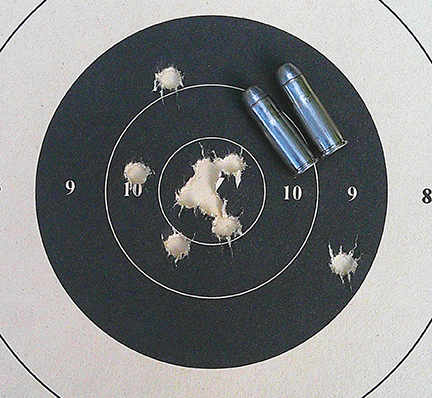
In that same match, we also shot a Bullseye target at 75 yards, again from the sitting position and over cross-sticks. On that target, my rifle put half of its shots into the 10-ring, which gave me a score of 95 for second place, with all shots cleverly avoiding the X-ring.
Some additional shooting was done which was even more pleasing. Another batch of ammo was loaded, dropping the powder charge down to 34.0 grains of Swiss 3Fg but adding a Walters .060 over powder wad. No wads were used in the previous loadings. In our Lever-Gun Matches we include a turkey target, which is shot offhand at just 25 yards. For my load testing, a small bullseye was posted at 25 yards and five shots were fired at it while using a benchrest. Those worked very well, making me wish I could shoot like that while standing on my hind legs!
That target was followed with another Bullseye target posted at 50 yards which was perforated with 10 shots, also fired from the bench. This is the target that did the most to help bullets from mould No. 43-215C win my heart. There are a couple of 9s showing on the target but this target has a score of 98-7X. I’ve shot good targets with the 205-grain bullets but not quite that good. Now it looks like the 215-grain bullets will become my standard.
Whether I will do any of the 300 and 400-yard shooting with my 44-40 that was mentioned by Dick Savage remains to be seen. However, a bullet must perform at short range before it can be really trusted at long-range and this bullet certainly shows me that it has what it takes to do the job. If I’m asked to suggest a bullet for the 44-40, especially with black powder loads, this is the bullet from Accurate Molds that I will recommend.