

45-70 Government
Is It Possible to Increase the Velocity Part I
feature By: Rick Moritz | June, 26
At the Deep Creek Range in Missoula, Montana, they host Black Powder Long-Range matches. These are shot at 800, 900, and 1,000 yards. They state on their website that “any original black powder caliber is allowed. However, a caliber that is entirely suitable for silhouette shooting may run out of steam at long-range. Without some advanced loading techniques, a 45-70 will have a difficult time. When it comes to .45 calibers, a 45-90 (45-2.4) would be a better choice.”
Unfortunately, the advanced loading techniques were not shared.
What if we could improve our reloading process and become a bit smarter with advanced techniques? Could we increase the velocity to around 1,300 feet per second (fps) or at least close to 1,280 fps? I set out to see if these higher velocities are possible. For this test, I won’t use 3Fg black powder granulation; I’ll stick to 1½Fg and 2Fg. Using 3Fg would make it easier to reach our target velocity. This could be a good alternative if coarser granulations can’t achieve the desired speed. In my opinion, large charges of 3Fg granulation can cause more leading and fouling due to higher combustion temperatures.
Five bullets were chosen to maximize case capacity and increase velocity. Alongside these, a control load has been included, which I previously used as a BPCR silhouette load. This load uses the Lyman Postell bullet with a charge of 55.6 grains of 3Fg Swiss powder. Thanks to the large lube grooves on the Postell bullet, a blow tube can be used if wiping between shots isn’t preferred. This load has been successfully used in BPCR Silhouette competition and offers a solid basis for comparison. This article is Part I, focusing on velocity with reasonable expectations for decent accuracy. Any standout loads will be further refined to improve accuracy and discussed in a future article. The goal is to attain the highest possible velocity, but the final results will depend on both accuracy and velocity. Part II, will focus on further developing any of the five bullets that show promise. If none demonstrate sufficient accuracy for further development, Part II will be very brief. Clearly, higher velocity can be achieved with more black powder. Duplex loading is an option but is not permitted in most black powder matches — hence the name, “black powder”. The 45-70 Govt. case size is fixed, but the overall cartridge length is flexible within reason. If the bullets are tapered or have a long bore-diameter section, the powder space could be increased by lengthening the Overall Cartridge Length (OAL). While rummaging in my reloading room, I was able to find five bullet candidates. As part of this current exercise, I have not developed any of the loads with accuracy in mind.
BULLETS
Referring to the Bullet Summary (Chart No. 1), Bullet No. 1 features a tapered Brooks mould of a “Money Bullet” design. This bullet seats quite deep in the case and is better suited for a 45-90 (45-2.4) or larger case. Bullet No. 2 is a Jones Money Bullet, used exclusively in my 45-90 for target rifle matches, including long-range shooting. It also seats deeply in the cartridge case. Bullet No. 3 is a Money Bullet type, a 0.450-inch diameter bullet designed for long-range use in muzzleloaders. Bullet No. 4 is a BACO custom mould of the Money Bullet design, featuring a very tapered profile. Only 0.240 inches are in the loaded case, and it could be loaded a little longer if desired. Bullet No. 5 is a Cunard paper patch bullet, which comes wrapped and ready to load.
LOADS
For bullets No. 1 and No. 2, I used only 2Fg Swiss because of the case volume limit imposed by the deep bullet seating requirement, as mentioned earlier and listed in the 45-70 Government Load Summary (Chart No. 2). Swiss 1½Fg might not provide the desired velocity due to the case capacity limit. Both Load No. 1 and Load No. 2 contained 70 grains of 2Fg Swiss.
Bullets No. 3, No. 4, and No. 5 were tested with two different charge weights and two granulations: 79 grains of 1½Fg Swiss and 75 grains of 2Fg Swiss. These charge weights were selected to keep the powder column heights as close as possible to the same distance from the case mouth and to allow for typical compression.
All loads used Winchester cartridge cases because they provided a greater case capacity than the Remington cases I also had available. Winchester Large Rifle primers and 0.090 low-density polyethylene wads were used in all the loads. An electric drop tube assisted in densifying the powder charge as much as possible. Note that the amount of powder that can fit in a case may vary between different lots. It was interesting that, with my available Swiss powder, I could load four more grains of 1½Fg Swiss in the cartridge case than of 2Fg Swiss.
Loads No. 1, No. 2, and No. 4 were loaded conventionally using 0.001 to 0.002 inches of neck tension.
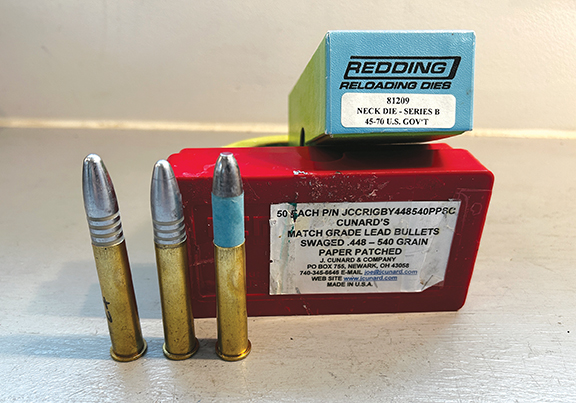
Loads No. 3 and No. 5 required special techniques to assist the loading process because they are both bore-diameter bullets. My rifle has a conventional 45-70 chamber set up for groove diameter bullets. To hold the bullets properly, I used a Redding 45-70 U.S. Government Neck Die (81209 NECK DIE-SERIES B 45-70 U.S. GOV’T). This die reduces the very end of the neck, allowing the case neck to retain the bullet during loading. With the neck die, I was able to reduce the inside dimension of the case neck to 0.448 inches, which was enough to hold the two different bore-diameter bullets. During loading, I had to tip the over-powder poly wads vertically to fit them through the reduced neck. Then, I used a wooden dowel to seat the wad squarely on the powder. It sounds more difficult than it was. I really doubted using bore-diameter bullets in the test, but you don’t really know what might happen until you try.
TESTING METHOD
Chronograph data was collected using the Garmin XERO C1 PRO for each shot. My preferred target for testing is Wyoming Schuetzen Union targets from SPG Sales. For my eyes, the 1 ½-inch white 25-ring is an ideal choice for aligning the scope crosshairs.
VELOCITY
Velocity ranged from a low of 1,216 fps to a high of 1,330 fps across five shots. The lowest velocity was recorded with the 540-grain Cunard paper patch (Load No. 5), using 79 grains of 1½Fg Swiss black powder. The highest velocity was achieved with the 535 BACO custom tapered bullet (Load No. 4) using 75 grains of 2Fg Swiss, reaching 1,330 fps. As expected, the 2Fg loads resulted in the highest velocities, although the charge weight was lower than that of the 1½ Fg Swiss loads. The charge weights are presented in Chart No. 2, and the velocities with associated statistics are shown in Chart No. 3.
The Lyman Postell “Control Load” had a velocity of 1,182 fps, achieved with 55.6 grains of 3Fg Swiss powder ignited by a Federal Large Pistol primer. This velocity is quite typical for a Mid-range or Silhouette load. I consider the 55.6 charge a light load of 3Fg. However, it has caused heavy barrel fouling under hot, dry conditions.
Apart from the paper patch loads, the standard deviations were very good to excellent. I would attribute this to annealed brass, consistent ammo, light neck tension, and soft primers. The velocity of the paper patch bullet was the lowest among the tested bullets. Comparing Load No. 4 to the paper patch bullet, the paper patch is approximately 55 fps slower when adjusting for the bullet weight difference (about 1 fps per grain). I’ve always thought the lower velocity of the paper patch bullet was due to less efficient sealing of the bore, allowing powder gas to escape. However, I recently read an article titled Beginner’s Guide to Long Range Muzzleloading, in the Winter 2017 edition of the Black Powder Cartridge News. Ray Hanson, a well-known long-range shooter, states that velocities with paper patch bullets are about 40 fps slower than with a grease groove bullet using the same powder charge. Hanson says that paper patch bullets create greater resistance in the bore. I would defer to Ray Hanson, as he has much more in-depth knowledge about paper patch bullets than I do.
ACCURACY
Since powder charge quantities were mainly chosen for velocity, I had low expectations for accuracy. The day I went to the range was quite windy, with gusts that changed rapidly. Large shifts in wind direction are common at my home range because it’s built in a canyon. Usually during winter, we experience very good conditions with little to no wind and high humidity – ideal for black powder testing.
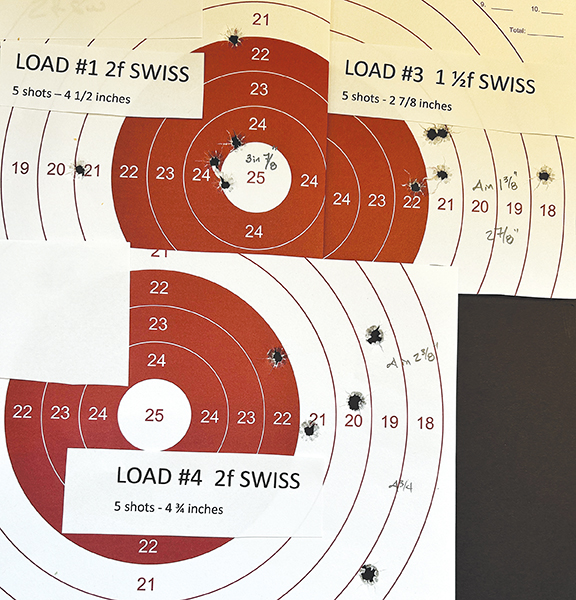
I was pleased with the results because I had not done any load development. I chose the charge weights listed in Chart No. 2 and tested them. The average group sizes were 4½Fg, 5½, 35⁄16, 51⁄8, and 53⁄16 inches for Load No. 1 through Load No. 5, respectively. There were a couple of pleasant surprises. I plan to follow up on three of the tested loads, specifically Load No. 1 – 1½Fg Swiss, Load No. 3 – 1½Fg Swiss and Load No. 4 – 2Fg Swiss.
The 517 Brooks (Load No. 1) had an overall five-shot group size of 4½ inches, with three shots landing within 7⁄8 inch. When I view the cluster of three shots, it makes me think that with some adjustments, this might be a very good long-range load. Although I wonder, are the three shots in the center representative or the two in the 21-ring? The 535 BACO bore-diameter bullet (Load No. 3) showed an average group size of 35⁄16 inches. However, four shots were grouped tightly at 13⁄8 inches. Keep in mind, this bullet is designed for use in a muzzleloader for long-range competition. Using the Redding neck sizer die, it was possible to reduce the neck to an inside diameter of 0.448 inches. The gripping area at the case neck is only a band about 1⁄10-inch wide, yet it seemed sufficient to hold the undersized bullet. Load No. 4, (the 524-grain BACO custom-tapered bullet with 2Fg Swiss), turned out to have the highest velocity in the test program at 1,330 fps. This velocity is ideal for long-range competition. The overall group size was 43⁄4 inches, and four shots landed within 23⁄8 inches.
CONCLUSION AND FUTURE PLANS
It was possible to achieve velocities more suitable for long-range shooting with the 45-70 Govt. cartridge. Three specific loads (Loads No. 1, 3, and 4) reached velocities just under 1,300 feet per second, with some up to 1,330 feet per second. Stay tuned for Part II!
.jpg)
.jpg)
.jpg)