


Bulk Smokeless Powders & Duplex Loading
feature By: Steve Garbe | April, 26
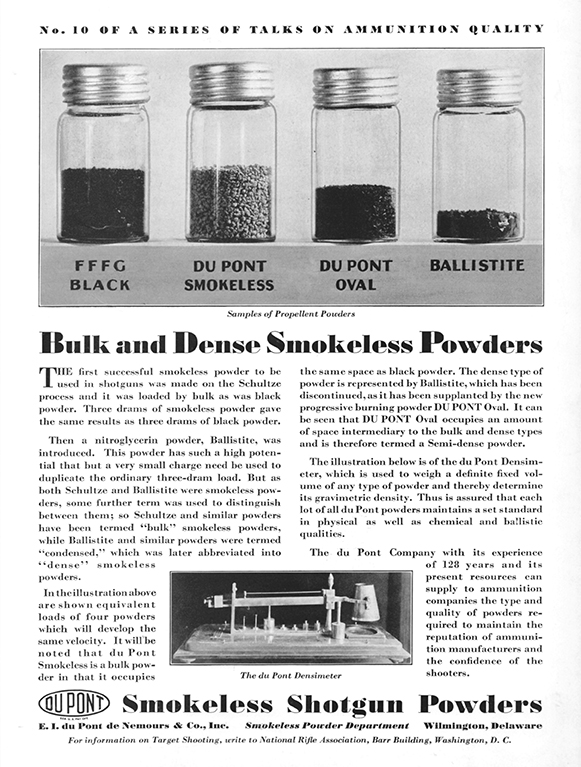
We ran across this ad by the DuPont Company in the December 1930, issue of the American Rifleman magazine. In reading old match reports from the late 1800s, one will often notice the listing of “Bulk Shot Gun” powder as an ingredient in old duplex Schuetzen rifle loads. Harry Pope, most notably, was very fond of this powder when using his duplex powder measure. Naturally, we were interested upon seeing this ad in the direct comparison between black powder, DuPont bulk smokeless, DuPont Oval and Balliste powders. Needless to say – a picture is worth a thousand words.
Many expert shooters, back in the day, mentioned the necessity of screening DuPont Bulk Shotgun Powder to get rid of “fines” and have uniformity of granulation. The DuPont “Oval” powder is one that I had not heard of before but is explained in the text as being between the bulk powders and the “Ballistite” nitroglycerin powder in bulk.
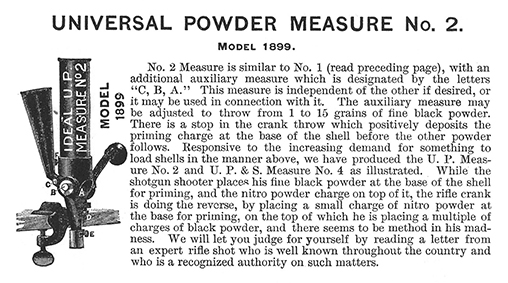
Duplex powder charges were very popular in the heyday of Schuetzen shooting and many of the top shooters used them. The old rule was that no more than 10 percent bulk measure of smokeless should be used based on a full charge of black powder. The advantage was that it significantly cut fouling from the black powder while still providing 100 percent load density. The Ideal Company offered a special duplex powder measure, the “Universal Powder Measure No. 2” (and later the improved No. 6 Model) set up specifically for this purpose.
Harvey Donaldson, the expert rifleman whose experience spanned the Schuetzen era to the beginning of modern benchrest shooting, had this to say about DuPont Bulk Smokeless powder:
“The white DuPont shotgun powder is not used as it comes from the canister, it first being screened and graded into three different lots according to the size of the grains. I use two small tea strainers for this purpose, one having eighteen mesh to the inch, and the other thirty. The powder is first passed through the eighteen-mesh screen, and what will not pass through is placed in a container and marked “Fg”. The remaining powder is put into the thirty-mesh screen, that which is held on the screen being marked “FFg”. The powder that has passed through is marked “FFFg”.
If the powder were used as it comes from the can there would be no way of knowing the percentage of fine grains to coarse, but by screening, uniformity is assured. I have found that the size Fg works well in the .38-55 case, while I use FFg in my .32-40 rifles and FFFg in the .25-20 S.S.
When any bulk powder such as DuPont shotgun, or Schuetzen, leaves the factory it has a moisture content of about two percent, and it is very important to maintain this moisture content. With powders used for Schuetzen loads I do this by keeping the powder in a tobacco humidor. When powder has been stored in a dry attic in hot, dry weather it will burn at a far different rate than if stored properly. That is why it is often impossible for anyone to give the correct charge of a bulk powder to use in Schuetzen loads.” From, Yours Truly, Harvey Donaldson, Wolfe Publishing, 1980.
Periodically, we have heard of attempts to re-create the old DuPont Bulk Smokeless powder, as well as the Semi-Smokeless propellant. Although there are numerous black powder “substitutes” on the market, to my knowledge none are close to what the older bulk propellants were, both in composition or performance. Personally, I think that the black powder substitutes available today are simply semi-smokeless bulk propellants utilizing completely different ingredients than black powder.
Duplex loading, such as what Harry Pope and many other expert riflemen used back in the heyday of Schuetzen shooting, has unfairly received a black eye amongst many modern-day riflemen. The main criticism voiced is that it is dangerous, especially when used with vintage firearms. There is a bit of truth in that idea, as it is possible to double the smokeless powder charge, resulting in higher pressures. The Pope measure, which was not adjustable for the smokeless charge, made double-charging impossible when operated in the correct manner. The Ideal No. 2 and later No. 6 Model powder measures could be adjusted for the smokeless charge. The Denver barrel-maker and gunsmith George Schoyen, also made a duplex powder measure, but I’m not familiar with its operation enough to say whether it had an adjustment for the smokeless priming charge. What the availability of all these various duplex measures shows is that duplex loading was a popular and much-used reloading technique in 1800s Schuetzen competition and is being unfairly castigated in modern times. We are including an advertisement from the Ideal Handbook No. 15 that includes a letter from noted rifleman E.A. Leopold, in regards to his use of the Ideal powder measure. His letter is interesting from the standpoint of technique and from the fact that Leopold was one of the recognized expert shooters in the late 1800s; duplex loading in Leopold’s time was a very accepted and widely used technique.
NOTE: I would caution the reader about Leopold’s smokeless and black powder charges. These have been used with old components not available today and should not be duplicated using modern powders or primers.
“Dear Sirs,
I have obtained the most uniform accuracy in rifle shooting by using black powder primed with about one-sixth its bulk of smokeless powder. Dense smokeless powders such as Walsrode, Gold Dust, etc., should not be used for this purpose, as they are apt to expand the shells. The proper kinds are such as are recommended by the manufacturers to be used in ordinary black powder rifles. Have had the best success with DuPont smokeless rifle No. 1; also with a mixture of this and King’s smokeless rifle No. 2, in equal parts. Other powders may do equally well, but, as a rule, shotgun smokeless powders are too violent in their action in a small bore rifle. I have loaded hundreds of shells as above described, using small scoops to dip up various quantities of smokeless and the old style flask for measuring the black, but it is a severe tax on time and patience.
The Ideal Universal Measure, either No. 2 or No. 4, does the work with neatness and dispatch. Having two adjustments, one for the smokeless and one for the black, they are easily and quickly changed to suit any cartridge on the market.
In making experiments with extremely long bullets, I found by putting coarse black powder next to the smokeless, and finer grained powder on top, the pressure in the barrel was kept down to a moderate amount, and yet a high velocity and fine accuracy were attained.
Putting three kinds of powder in the shell by the old methods was more than tedious. The Ideal Measure No. 4 does this work perfectly in .32 caliber and larger, by putting powder, instead of shot, in the shot cylinder; it puts three kinds of powder, one above the other, without mixing, in each shell, as rapidly as one kind could be handled by the old method.
The ordinary black powder primers work all right, as a rule, when smokeless priming is used, but an occasional hang fire has been attributed to them, so I am using the U.M.C. nitro primers, Nos. 6 ½ and 7 ½, and find them all right.
For target shooting an air space of about 1/8th of an inch works well; a large airspace often leads to inaccurate shooting.
In many cases, the accuracy of fixed ammunition is impaired by seating the bullet too far into the shell.
When I speak of black powder I mean rifle powder, not shotgun powder, and I find DuPont’s and Hazard’s equally reliable. Have not had much experience with other makes as they are not on sale here.
The new Model 1899 Measures are so thoroughly adjustable from the smallest to the largest charges desired, and the delivery is so very uniform and accurate, that they are indispensible for the shooter who is of an experimental turn of mind.
Yours truly,
E.A. Leopold
Norristown, PA.
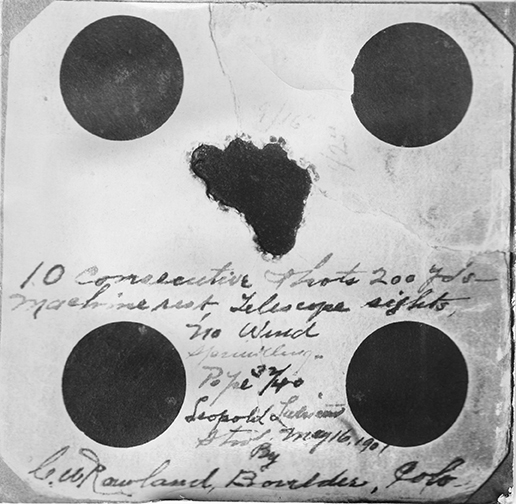
Another fact concerning historical use of duplex loads is that the long regarded “Holy Grail” of single shot rifle shooting, namely Charles Rowland’s record group of 10 shots into .722 from rest at 200 yards was almost certainly done with a duplex load. I say “almost certainly” because there is the possibility that he used a load other than his reported standard 32-40 load. Personally, it is my opinion that Rowland’s standard duplex load was the one he used to make the record group and I’m joined in that opinion by many other riflemen who have researched Rowland and his techniques. The load that Rowland very likely used in his H.M. Pope-barreled Ballard 32-40 rifle, as reported in John T. Dutcher’s excellent book Ballard, The Great American Single Shot Rifle, was taken from a 1902 article in Outdoor Life magazine and was as follows:
“The load used in making this target was 3 grains No. 1 Dupont smokeless, 7 ½ U.M.C. primer, and the shell filled nearly full with hazard Fg powder, making a bulk charge of about 46 grains. Before using the powder it was very carefully sifted through several sieves to be perfectly sure that it was of even grain. The bullets were (cast) 1-10, lubricated with Leopold’s No. 6 lubricant. Oleo grease wads were employed. The rest was a Stevens-Pope No. 1 rear and No. 2 front, supported on a very heavy wooden frame, deeply seated in the earth, and strongly braced.”
DuPont No.1 was an early iteration of what was to eventually become IMR 4759, a commonly used powder for duplexing in more recent times. Unfortunately, it has been discontinued and so IMR 4227 has moved into its place as a suitable powder for duplexing with black. Powders of equivalent burning rates should work, but I prefer to stick to the single-base IMR powders. We obviously don’t have access to many of the powders used in the early 1900s for duplexing, so take that into consideration when reading of recommended charges in old literature. If, by chance, one would run into some of the old powders, I would be very cautious about using them as early smokeless or semi-smokeless powders degraded quickly. It’s not worth the risk of using an old powder that has deteriorated to the point of drastically changing its burning characteristics.
To those who regard duplex loading as “dangerous” or “not historical” one could say that reloading any ammunition can be dangerous if care is not taken in all the procedures. Done correctly, duplex loading is not any more dangerous than any other method. In my opinion, there has been many more vintage black powder rifles ruined by incorrect straight smokeless charges or unsafe reloading practices than by duplex loads. If one has any doubts about their ability to safely reload duplex cartridges, then the recommended course of action would be to stick to using straight black powder.
With the historical information presented here, I think that even the most outspoken critic will have to admit that duplex loading was just as a traditional Schuetzen method as the early use of smokeless powder. Riflemen in the late 1800s and early 1900s, were keen to use any advancement in powder and primers to secure better and more reliable accuracy from their firearms. For us to dismiss it as a little-used or dangerous technique is short sighted, uninformed and certainly not consistent with documented history.
However, if the intent of a competition is to re-create the difficulties experienced by early-day black powder riflemen or hunters in regards to the successful use of straight black powder loads, then duplex or smokeless ammunition is totally inappropriate. It is also inappropriate if our goal is to match our skill against those early day shooters and the records that they set. If you want to break the old records, then you have to use the equipment that was available at the time the record was set. We have the luxury at this point in time to be able to pick and choose what equipment we define as “traditional” and what restrictions we impose at specific rifle matches. Many of our traditional rifle matches could best be described as “Model T Racing” – challenging and educational competitions with a historically defined limit on technology. The challenge is to keep our competitions consistent with history and not attempt to re-write it to suit our fancy or misconceptions.