

The Black Powder Cartridge News Spring 2026
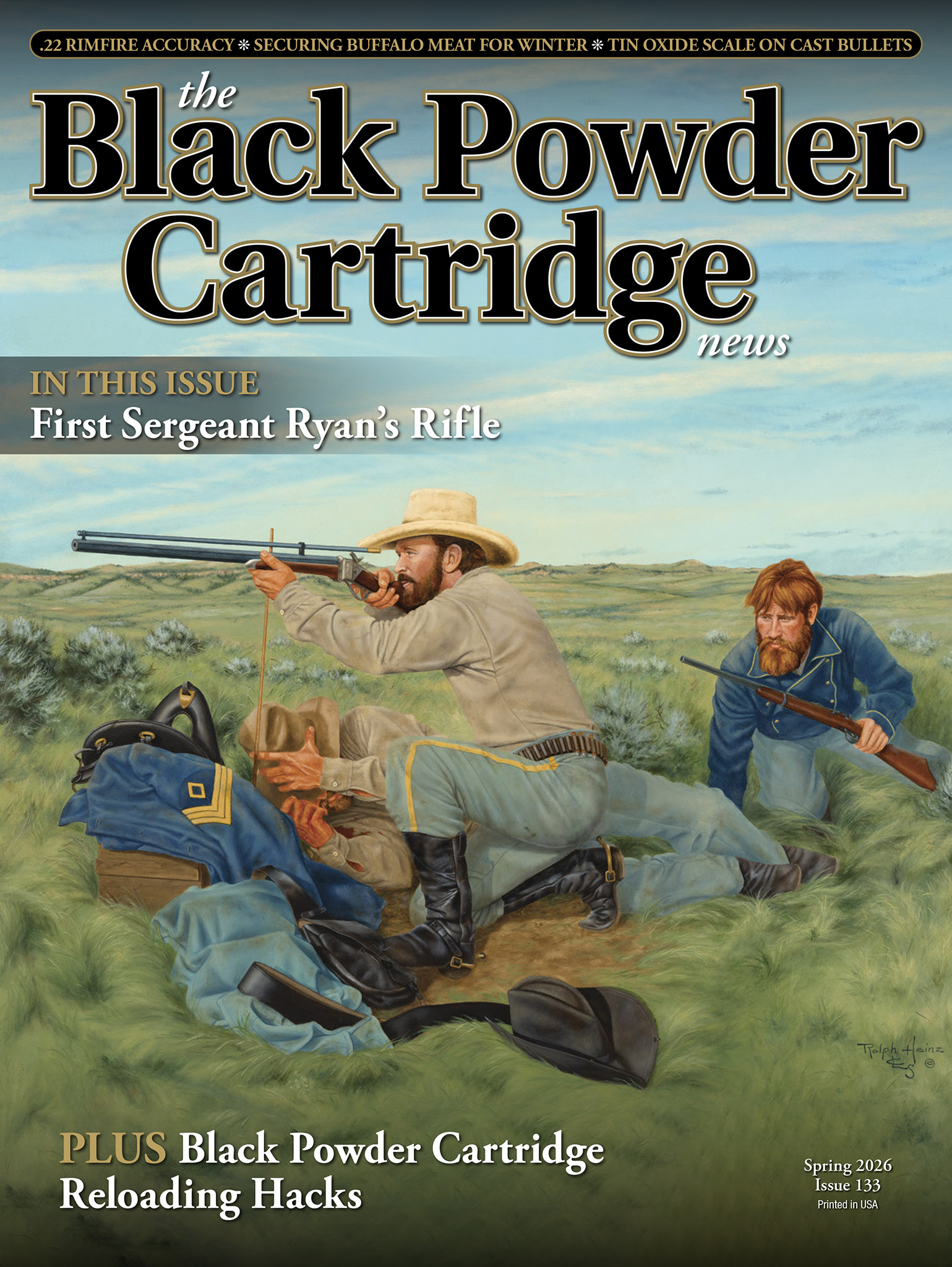
On the Cover: Our cover this issue features artwork by well-known Western artist Ralph Heinz of Newport, Washington, depicting First Sergeant John M. Ryan returning fire from his position at the Battle of Little Big Horn.
Volume , Number | ISSN:
Article Bites
From the Editor
A New Black Powder Record?
column by: Steve Garbe
In conversations with fellow riflemen about black powder shooting, the topic of what the 200-yard, black powder, lead bullet record was from the old days often comes up. My answer has always been that it’s a little hard to nail down, as there were many groups submitted by expert riflemen to the various periodicals of the day. Some of these groups were shot with straight black powder loads, some with duplex and even a few done with early smokeless powder. ...Read More >
Letters from Readers
Now is The Time to Speak Up / .22 Rimfire Ammunition Ballistic Statistics vs Accuracy
column by: Ed Decker, Lon E. Morris
Dear Editor, I began to shoot competitively in 1957. My first long- range match was at Camp Perry shooting with the Army Rifle and Pistol Team. In 1959, I joined the NRA and had a subscription to the American Rifleman magazine and could not wait to get the next issue, like I do now with the Black Powder Cartridge News. ...Read More >
Industry News
Sharps Rifle Company Archives
column by: Tisha Johnson
To whom it may concern,The Sharps Rifle Co. Archive is proud to announce that we will be continuing the work of providing you with serial number documentation from the original records of the Sharps Rifle Company. ...Read More >
Product Reviews
Montana Vintage Arms Scope Sunshade / SPG Sales Rifle Restore
column by: Steve Garbe
Scopes on BPC rifles are becoming more and more common as the years go by, probably for a very good reason. Most of us are dealing with aging eyes, and scopes simply let us shoot and compete more effectively. Montana Vintage Arms is the supplier of what many serious riflemen regard as the best scope available today and as such, is also offering some great accoutrements to go with those scopes. One new item that has just been offered is a three-inch long sunshade that fits on the objective end of the MVA scope and is really a necessary accoutrement. ...Read More >
The Wyoming Schuetzen Union’s “Center Shot”
Belding and Mull’s Famous .30 Caliber Bullets
column by: Jim Foral
The stateside effects of WWI wore on the whole of American citizenry. If that era’s handloaders imagined that they would escape being affected, they were mistaken. United States arms manufacturers, ammunition plants, and industrial shops curtailed normal domestic production to pursue necessary war contracts. Thus, the American gun crank was – at a minimum – inconvenienced by the arms and ammunition shortages the fracas created. ...Read More >
Rifle Clubs
column by: Editor
... ...Read More >
First Sergeant Ryan’s Rifle
feature by: Mike Nesbitt
Nearly 150 years have passed since the famous “Battle of Greasy Grass,” which many of us remember better as the “Battle of the Little Big Horn.” At the battle “M” Company, 7th Cavalry, First Sergeant John Ryan, used his 45-70 Sharps rifle and fired the last shot of this famous conflict with the Cheyenne and the Sioux. However, that last shot is not what Ryan’s rifle is best remembered for. What is remembered more is the shooting done by Sgt. Ryan with his rifle when firing at Sharpshooter Ridge. Those shots most likely saved Ryan’s life, plus the lives of other troopers in “M” Company. ...Read More >
.22 Rimfire Accuracy
Logic, Reason, Chronograph and Statistics
feature by: Bob Glodt
With the recent introduction of radar technology in chronographs, more shooters are using chronographs to evaluate the performance of rimfire ammunition in their rifles. Radar-based chronographs, such as the Garmin Xero C1 Pro are compact, easy to use and quick to set up. The cumbersome sky screens of old are not used with this new technology. My Garmin will fit into my shirt pocket, and the data from each shooting session can be downloaded to my cell phone. Because the Garmin is so easy to use, I always chronograph rimfire ammunition when shooting for groups. ...Read More >
Black Powder Cartridge Reloading Hacks
feature by: Rick Moritz
A “hack” is a technique or method to make a task easier or more efficient. Simplifying some reloading steps can save time and potentially improve the quality of your ammunition. There is no benefit in doing something quickly if it results in a less desirable product. Unfortunately, loading good-quality match ammo takes time and effort. I am willing to spend the time to produce very accurate black powder ammunition. ...Read More >
Bulk Smokeless Powders & Duplex Loading
feature by: Steve Garbe
We ran across this ad by the DuPont Company in the December 1930, issue of the American Rifleman magazine. In reading old match reports from the late 1800s, one will often notice the listing of “Bulk Shot Gun” powder as an ingredient in old duplex Schuetzen rifle loads. Harry Pope, most notably, was very fond of this powder when using his duplex powder measure. Naturally, we were interested upon seeing this ad in the direct comparison between black powder, DuPont bulk smokeless, DuPont Oval and Balliste powders. Needless to say – a picture is worth a thousand words. ...Read More >
32-40 Ballard
Miniature, Short-Range and Gallery Loads
feature by: William M. Curry, Jr.
The 32-40 Ballard cartridge (also known as the 32-40 Winchester and Marlin) was created by Ballard in 1884, as a target cartridge loaded with a 165-grain bullet and 40 grains of black powder. It is based on the 38-50 Ballard Everlasting and the 38-55 Ballard necked down to take a .319 to .324-diameter bullet. It also has applications as a hunting cartridge from small game to deer, depending on the loading. The 32-40 was loaded to several different power levels ranging from gallery, miniature and short range, through standard black powder, smokeless low pressure to various versions of high velocity including the Remington “High Power” load that was equal to both the 30-30 WCF and 32 Winchester Special. ...Read More >
Securing Buffalo Meat for Winter Part II
On the Plains of Western Kansas
feature by: Floyd B. Small (Submitted by Leo J. Remiger)
In his introduction to Autobiography of a Pioneer, Floyd B. Small wrote: “The best years of my life have been spent in the preparation of this book. I hope it will receive the courteous treatment that I feel is due me in my declining years, for I have certainly paid some top prices for the information it contains. It contains about 67,000 words that I believe will be found both instructive and interesting.” ...Read More >
Tin Oxide Scale on Cast Bullets
feature by: Lon Morris
Oxidation is defined several ways. The early definition of “oxidation” is simply put as “the combination of a substance with oxygen.” However, as technology increased an additional definition was added, again simply put “a reaction in which the atom of an element loses electrons and the valence of the element is corresponding increased.” The latter definition was further amended to include “reduction” which happens when a substance gains an electron versus “oxidation” when substance loses an electron. ...Read More >